
The special session of the Oswaldo Cruz Institute Study Center (IOC/Fiocruz), held on Friday (28/03), marked the last day of programming for the Opening Week of the Academic Year.
The meeting reflected on the concept of Citizen Science, an approach that involves society in the construction of scientific knowledge, and gave examples of its application in IOC and in other institutions.
The lecture 'Citizen Science, experiences and intersection with teaching' was presented by the assistant professor of the Center for Natural and Human Sciences at the Federal University of ABC (UFABC), Natalia Pirani Ghilardi-Lopes.
The mediation was carried out by the Institute's vice-director of Research, Technological Development and Innovation, Luciana Garzoni.
The entire Academic Year schedule is available here. Watch the full broadcast on channel IOC on Youtube.
Luciana began the session with a brief contextualization about the performance of IOC in Citizen Science. According to the vice-director, the recommendation is to encourage the population's participation in the critical and reflective evaluation of the local reality, as well as in tasks such as formulating questions for questionnaires and/or data collection.
“It is important to involve the population in these tasks so that they recognize the problem and so that we, as scientists, can listen to their stories. And, together, we can think of solutions to face health challenges. It is not about 'doing for', but 'doing with',” he commented.
The project 'Community-Based Epidemiological Surveillance in Vulnerable Areas Exposed to Urban Violence' was one of the examples cited by the deputy director. The initiative was born from the demand of the population itself and aimed to support communities in Duque de Caxias, Belford Roxo and Nova Iguaçu in combating the Covid-19 pandemic.
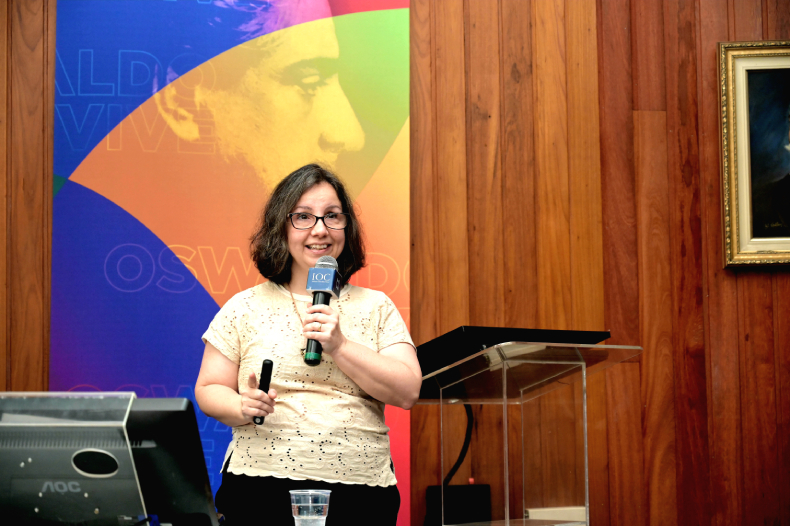
Next, Natália expanded theoretical reflections and contextualized Citizen Science for current discussions, such as the fight against fake news. According to the researcher, access to “scientific practice” also reduces distrust around science and strengthens critical thinking.
“When the population is familiar with the scientific process and how it works, they are able to question some of the information they receive,” he said.
The special session of the Oswaldo Cruz Institute Study Center (IOC/Fiocruz), held on Friday (28/03), marked the last day of programming for the Opening Week of the Academic Year.
The meeting reflected on the concept of Citizen Science, an approach that involves society in the construction of scientific knowledge, and gave examples of its application in IOC and in other institutions.
The lecture 'Citizen Science, experiences and intersection with teaching' was presented by the assistant professor of the Center for Natural and Human Sciences at the Federal University of ABC (UFABC), Natalia Pirani Ghilardi-Lopes.
The mediation was carried out by the Institute's vice-director of Research, Technological Development and Innovation, Luciana Garzoni.
The entire Academic Year schedule is available here. Watch the full broadcast on channel IOC on Youtube.
Luciana began the session with a brief contextualization about the performance of IOC in Citizen Science. According to the vice-director, the recommendation is to encourage the population's participation in the critical and reflective evaluation of the local reality, as well as in tasks such as formulating questions for questionnaires and/or data collection.
“It is important to involve the population in these tasks so that they recognize the problem and so that we, as scientists, can listen to their stories. And, together, we can think of solutions to face health challenges. It is not about 'doing for', but 'doing with',” he commented.
The project 'Community-Based Epidemiological Surveillance in Vulnerable Areas Exposed to Urban Violence' was one of the examples cited by the deputy director. The initiative was born from the demand of the population itself and aimed to support communities in Duque de Caxias, Belford Roxo and Nova Iguaçu in combating the Covid-19 pandemic.
Next, Natália expanded theoretical reflections and contextualized Citizen Science for current discussions, such as the fight against fake news. According to the researcher, access to “scientific practice” also reduces distrust around science and strengthens critical thinking.
“When the population is familiar with the scientific process and how it works, they are able to question some of the information they receive,” he said.
The non-profit reproduction of the text is allowed as long as the source is cited (Comunicação / Instituto Oswaldo Cruz)
 |
 |
