
:: Read more about the WIN Network
The perspectives and challenges faced with the impact of resistance to insecticides on the control of mosquitoes that transmit arboviruses, especially Aedes aegypti, vector of dengue, Zika and chikungunya viruses, guided the meeting that marked one year since the creation of the International Network of Resistance to Insecticides (WIN). Among the group of national and international researchers that make up the Network are specialists from the Oswaldo Cruz Institute (IOC/Fiocruz). The meeting was held on May 04th and 05th, in Rio de Janeiro.
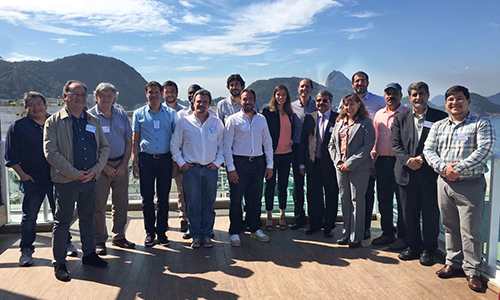
 Network members act in the development of studies to map resistance to insecticides by mosquitoes Aedes aegypti in different locations around the world. Photo: Gutemberg Brito
At the strategic meeting, the scientists evaluated the first year of activities and defined the next steps.
"We united researchers from institutions in different countries and formed a very collaborative group. At this meeting we were able to assess the initial objectives, progress and achievements up to now. We are also planning the expansion of the Network and the establishment of new partnerships", emphasized Ademir Martins, researcher from the Laboratory of Physiology and Control of Vector Arthropods of the IOC and member of the executive committee of the WIN Network.
The researchers also discussed guidelines that involve the future of the Network, considering the expansion, scope and search for new sources of funding.
"We renew our commitment to keeping the existing network active. I believe this will enable us to support the World Health Organization and local and regional resistance monitoring networks in Aedes aegypti, contributing to vector control," he concluded.
During the first year, the members of the Network dedicated themselves to the elaboration of several studies.
These include research on strategies to improve resistance management and vector control of emerging arboviruses; overview of resistance in relation to the main vectors of pathogens that infect humans; alternative methods of mosquito control; and integrated approach to the management of Aedes transmitted diseases.
Also in 2016, the group held a international meeting that brought together more than 150 participants from 30 countries during the Workshop Insecticide resistance in vectors of emerging arboviruses: challenges and prospects for vector control.
:: Read more about the WIN Network
The perspectives and challenges faced with the impact of resistance to insecticides on the control of mosquitoes that transmit arboviruses, especially Aedes aegypti, vector of dengue, Zika and chikungunya viruses, guided the meeting that marked one year since the creation of the International Network of Resistance to Insecticides (WIN). Among the group of national and international researchers that make up the Network are specialists from the Oswaldo Cruz Institute (IOC/Fiocruz). The meeting was held on May 04th and 05th, in Rio de Janeiro.
Network members act in the development of studies to map resistance to insecticides by mosquitoes Aedes aegypti in different locations around the world. Photo: Gutemberg Brito
At the strategic meeting, the scientists evaluated the first year of activities and defined the next steps.
"We united researchers from institutions in different countries and formed a very collaborative group. At this meeting we were able to assess the initial objectives, progress and achievements up to now. We are also planning the expansion of the Network and the establishment of new partnerships", emphasized Ademir Martins, researcher from the Laboratory of Physiology and Control of Vector Arthropods of the IOC and member of the executive committee of the WIN Network.
The researchers also discussed guidelines that involve the future of the Network, considering the expansion, scope and search for new sources of funding.
"We renew our commitment to keeping the existing network active. I believe this will enable us to support the World Health Organization and local and regional resistance monitoring networks in Aedes aegypti, contributing to vector control," he concluded.
During the first year, the members of the Network dedicated themselves to the elaboration of several studies.
These include research on strategies to improve resistance management and vector control of emerging arboviruses; overview of resistance in relation to the main vectors of pathogens that infect humans; alternative methods of mosquito control; and integrated approach to the management of Aedes transmitted diseases.
Also in 2016, the group held a international meeting that brought together more than 150 participants from 30 countries during the Workshop Insecticide resistance in vectors of emerging arboviruses: challenges and prospects for vector control.
The non-profit reproduction of the text is allowed as long as the source is cited (Comunicação / Instituto Oswaldo Cruz)
 |
 |
