
Imagine being able to go back in time and see with your own eyes beings that existed in some regions during a certain period. Thanks to the commitment of scientists from different eras, we can have the experience of getting in touch with rare specimens from the most different times and spaces.
Completing 120 years of activity, the Entomological Collection of the Oswaldo Cruz Institute (CE)IOC) is a true exhibition of biodiversity. With about 5 million insects, it is recognized as the oldest biological collection of the Oswaldo Cruz Foundation (Fiocruz) and one of the most valuable collections in Latin America.
“It's a biological collection with material from regions that are already very different today, in terms of natural appearance. If we go back to the places where many of these insects were collected, we will no longer find these species, because what used to be areas of forest are now made of concrete and asphalt, or have become fields of agricultural activities. Biological diversity is one of the riches of this set”, highlighted Márcio Felix, current curator of the Entomological Collection of the IOC.

The rich collection of insects has a very broad and unique representation of the Brazilian fauna, with specimens from all biomes present in the national territory. In addition, there is also a large number of specimens from different regions of the world. Altogether, the Collection lists materials from approximately 120 countries and from all continents on the planet, ranging from mosquitoes from tropical regions to lice that parasitize mammals in the freezing climate of Antarctica.
“Insects are the largest group of living beings in the world in number of species. And in the Entomological Collection of IOC we have almost all known orders. You can find beetles, butterflies, moths, wasps, bed bugs, ants, bees and much more. The list is long”, pointed out Márcio.
Despite being currently focused on the representation of biodiversity, the ECIOC it has many insects that were fundamental for public health studies. Among them, the triatomines, popularly known as kissing bugs, which contributed widely to discoveries about the transmission of Chagas disease, and several culicids (mosquitoes), which brought answers about yellow fever, malaria, dengue, among other infections.
There is also a large number of specimens of high historical and scientific relevance such as type specimens, that is, the first beings found of those species and which were used to define their characteristics. One of these specimens are the type specimens of the anopheles lutzii, used by Oswaldo Cruz in 1901 to describe the then newly discovered species of mosquito. Items are considered as the starting point of ECIOC.
“These materials have immeasurable historical relevance due to their antiquity and because they were the work items of important scientists. In addition to preserving the memory of these insects, they also tell the story of the life and work of researchers,” said Felix.

Although it does not have an exact date of creation, the Entomological Collection of IOC has a document that can be compared to a birth certificate. On November 15, 1901, Oswaldo Cruz published the description of the mosquito anopheles lutzii, transmitter of malaria, in Revista Brasil Médico. The publication is a milestone for being the institution's first scientific article (at the time called the Federal Serotherapy Institute) and for generating what would be the first deposit of type specimens from the oldest biological collection in the world. IOC and from Fiocroz.

Research with insects at the Institute (mainly with flies and mosquitoes) gained focus in that period, which enabled the rapid expansion of the collection. Important names in science such as Carlos Chagas, Adolpho Lutz, Arthur Neiva, Costa Lima, Fábio Werneck, among others, participated in these studies. Currently, most of its finds and studied specimens belong to the EC Historical CollectionsIOC.
“The growth of the collection, especially in the first half of the XNUMXth century, occurred thanks to the intense research activity in entomology that existed in the IOC in season. The researchers carried out important expeditions through different regions of Brazil, attending to the most different public health problems. During this period, many specimens of medical and general importance were collected”, explained the curator of the collection.
In the 1950s, the Collection incorporated insects from the Helminthology Laboratory and its set began to have a format more similar to the current one. The insects were housed in a three-story metallic structure located on the 2nd floor of the maximum symbol of Fiocruz, the Moorish Castle, in Manguinhos, in Rio de Janeiro.
However, the history of the ECIOC it cannot always follow an ascension line. In 1970, during the military dictatorship, the collection faced a great scenario of neglect. In the episode known as “Massacre de Manguinhos”, the insect collection had its physical structure completely dismantled and part of its history faded away.
“Several researchers were dismissed; among them, the entomologists Hugo de Souza Lopes, who assumed the curatorship of the Collection, Herman Lent and Sebastião José de Oliveira. The collection was removed from the Castle and part of it was improperly transported to a basement, where it remained for six to seven years in improper conditions, causing irreversible damage not only to the material, but also to the documentation, which included record books. To this day, we try to recover situations of damage that occurred at that time”, said Felix.
The Collection returned to Castelo Mourisco around 1976. However, the scientific activities developed from the material were only fully reestablished after Brazil's re-democratization, when Sebastião José de Oliveira, one of the scientists impeached during the military period, took over the curatorship of the collection. . Despite having returned to receive curatorial care in a more appropriate way, the space did not yet have an adequate structure to host such valuable items – a scenario that remained until 2008, when a major renovation and restoration was completed in rooms 210 and 215 , which currently house the ECIOC.
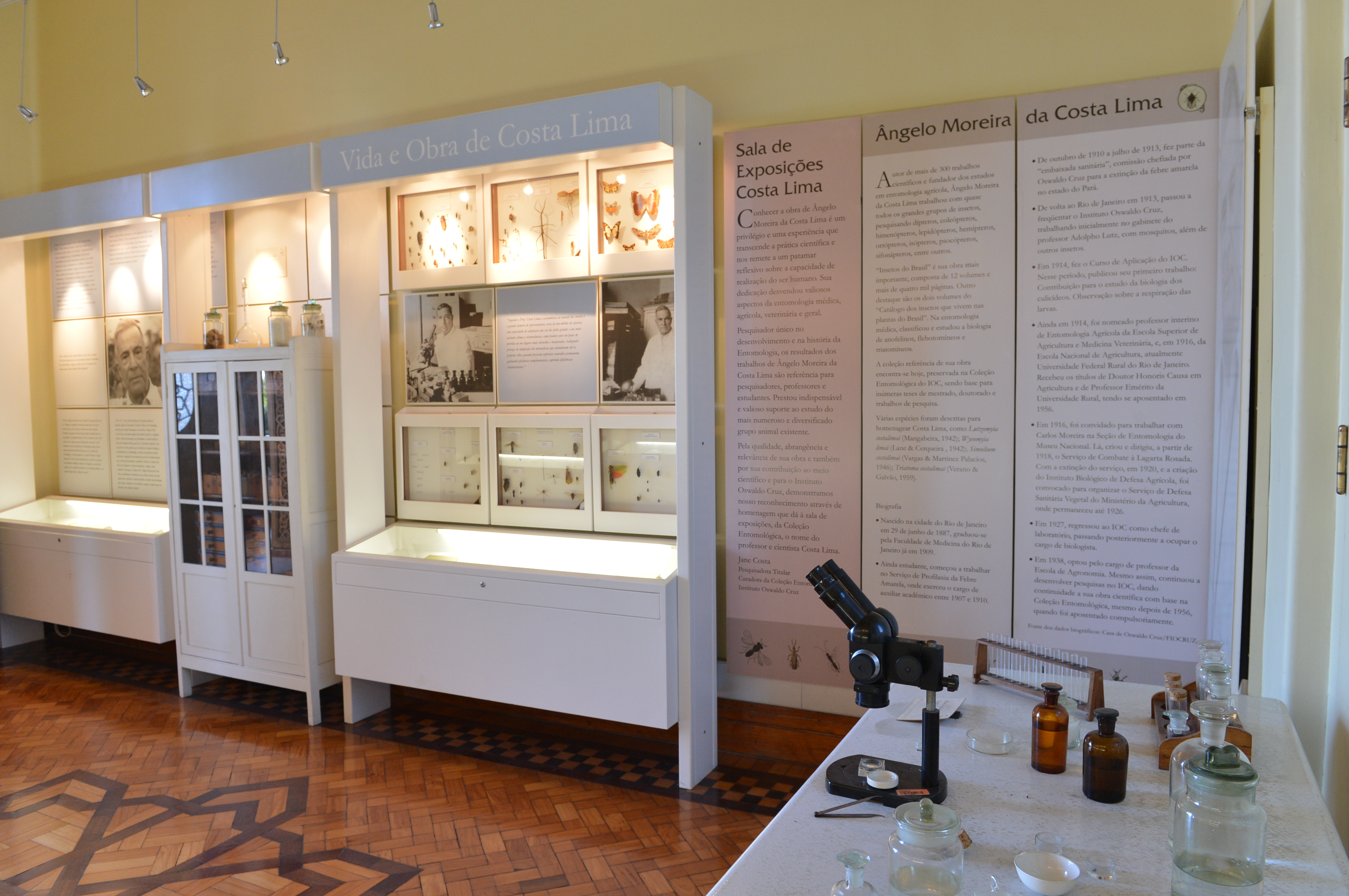 Space opened on September 24, 2008, provides an overview of the group of insects. Photo: Gutemberg Brito
Gradually, with a lot of persistence and dedication, the Entomological Collection of the IOC it was resuming its good conditions for preserving the biodiversity of insects and helping scientific research. Facilitating access to this important collection has been one of its main focuses in recent decades. Among the actions carried out are the publication of scientific articles with lists of types, online sharing of specimen data and the development of specimen catalogues.
“One of our main current goals is to catalog copies of the Historical Collections to preserve this memory, also in digital format. We used a photography platform to capture images not only of the insects, but also of files and documents handwritten by these renowned researchers. We are currently working on the Costa Lima Historical Collection”, highlighted Márcio.
In the future, all this construction of knowledge and the centenary path taken by the Entomological Collection may also inhabit pages of a book about the collection. “We are making an effort to recover the history of the Collection in more detail in order to enable the production of a work that will tell the history of the CEIOC”, concluded the curator.
The number of five million copies is already impressive. However, in full scientific activity, the ECIOC accepts deposits of properly preserved specimens with associated information. The most recent deposit was made by the Entomological Biodiversity Laboratory of the IOC in October 2021, with the addition of 94 batches of different species of water bugs collected in several states in the North, Midwest and Southeast regions of Brazil.
“A large entomological collection will always add a lot of diversity. When it comes to insects, the numbers are always huge. It is the group with the largest number of species known to science, with just over a million described beings. And, without a doubt, there is still a much larger number to be discovered”, reported Márcio Felix.

With its vast diversity, the ECIOC provides services mainly of consultation, loan and deposit of copies. The specialties of the professionals who make up the Collection team also allow consulting services in entomology and identification of specimens, as well as training and qualification of human resources to work in entomological collections.
The contact for these services is through the email address: ceioc@fiocruz.br.
The Entomological Collection of the IOC it is a heritage that can be visited not only by researchers who seek to deepen their studies, but can also be accessed by all those who wish to have contact with this historical material. In the Costa Lima Exhibition Room, in Castelo Mourisco, various historical items are available, such as publications, furniture and insects that call attention for their aesthetics.
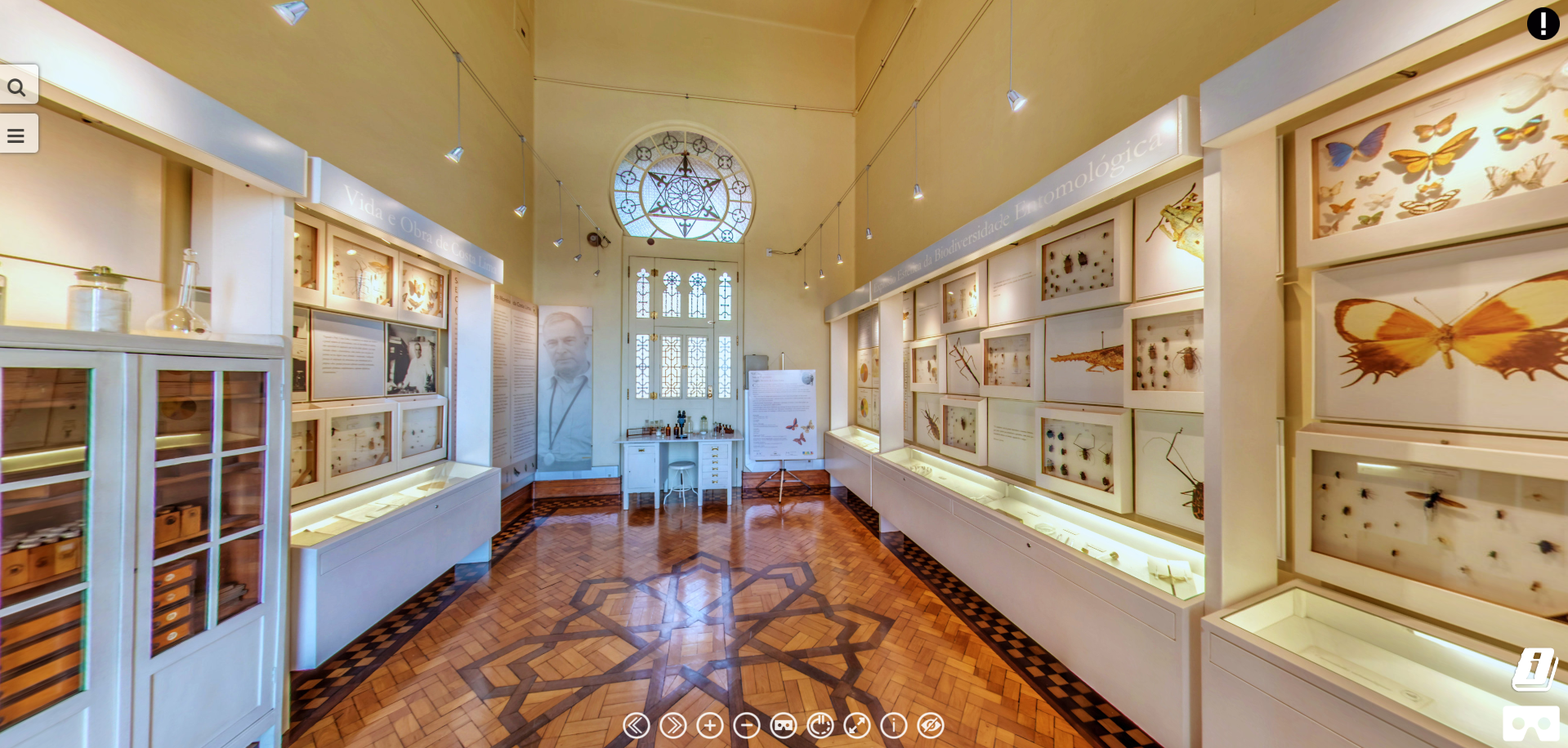 Screenshot of the virtual tour of the Costa Lima Exhibition Room. Photo: reproduction
At the moment, the physical space is closed to visitors due to the Covid-19 pandemic and the preservation reforms that are being carried out at the Castle. However, it is possible to carry out a virtual tour in which the visitor has a complete immersion with a 360° viewing experience. It is possible to climb the stairs of the Moorish Castle and walk to the Costa Lima Exhibition Room. In the space, the visitor will be able to see the items on display and learn more about them through the detailed captions that appear on the screen throughout the visit.
Click here to access the virtual tour.
Accessibility and social inclusion have been significant features of the Entomological Collection of IOC in the last decades. Researchers and collaborators who are part of the curatorship of the Collection have taken on the challenge of ensuring that this rich collection continues to reach a large number of people and also goes beyond the limits of Castelo Mourisco.
In addition to the online tour, which allows a virtual tour from any region of the world, the Collection is a guaranteed attraction at various scientific dissemination events inside and outside the limits of the Manguinhos campus, highlighting the beauty and peculiarity of insects for audiences from different age groups and locations.
And speaking in public, the Collection has focused on making access to information more equal in the Costa Lima Exhibition Room. One Deaf community initiative, created in 2013, promotes face-to-face visits accompanied by sign language interpreters for greater integration.
Translation into pounds and panels with audio description also facilitate public interaction at EC eventsIOC. One of the highlights in the use of these resources was the exhibition "Illustrated Insects", organized by the Museu da Vida da Casa de Oswaldo Cruz (COC/Fiocruz). The initiative, which highlighted the importance and beauty of scientific illustrations, featured specimens from the Rare Works Section of the Manguinhos Library and, of course, insects from the Entomological Collection of the IOC.
The diversity of the collection and the knowledge accumulated over its 120 years of activity also serve as inspiration for the production of literary works, such as the children's book "The Butterflies, the Beetle and the Fairy of Biodiversity". The publication, authored by Jane Costa (who has already acted as a curator of the CEIOC) and Lucas Torres, both from the Entomological Biodiversity Laboratory of the IOC, has illustrations of different specimens present in the Entomological Collection. "Stimulation and support for initiatives to publicize the Collection, highlighting the richness of the diversity it contains and its history, make up a guideline for the current curatorship", reinforced Márcio Felix.
Imagine being able to go back in time and see with your own eyes beings that existed in some regions during a certain period. Thanks to the commitment of scientists from different eras, we can have the experience of getting in touch with rare specimens from the most different times and spaces.
Completing 120 years of activity, the Entomological Collection of the Oswaldo Cruz Institute (CE)IOC) is a true exhibition of biodiversity. With about 5 million insects, it is recognized as the oldest biological collection of the Oswaldo Cruz Foundation (Fiocruz) and one of the most valuable collections in Latin America.
“It's a biological collection with material from regions that are already very different today, in terms of natural appearance. If we go back to the places where many of these insects were collected, we will no longer find these species, because what used to be areas of forest are now made of concrete and asphalt, or have become fields of agricultural activities. Biological diversity is one of the riches of this set”, highlighted Márcio Felix, current curator of the Entomological Collection of the IOC.
The rich collection of insects has a very broad and unique representation of the Brazilian fauna, with specimens from all biomes present in the national territory. In addition, there is also a large number of specimens from different regions of the world. Altogether, the Collection lists materials from approximately 120 countries and from all continents on the planet, ranging from mosquitoes from tropical regions to lice that parasitize mammals in the freezing climate of Antarctica.
“Insects are the largest group of living beings in the world in number of species. And in the Entomological Collection of IOC we have almost all known orders. You can find beetles, butterflies, moths, wasps, bed bugs, ants, bees and much more. The list is long”, pointed out Márcio.
Despite being currently focused on the representation of biodiversity, the ECIOC it has many insects that were fundamental for public health studies. Among them, the triatomines, popularly known as kissing bugs, which contributed widely to discoveries about the transmission of Chagas disease, and several culicids (mosquitoes), which brought answers about yellow fever, malaria, dengue, among other infections.
There is also a large number of specimens of high historical and scientific relevance such as type specimens, that is, the first beings found of those species and which were used to define their characteristics. One of these specimens are the type specimens of the anopheles lutzii, used by Oswaldo Cruz in 1901 to describe the then newly discovered species of mosquito. Items are considered as the starting point of ECIOC.
“These materials have immeasurable historical relevance due to their antiquity and because they were the work items of important scientists. In addition to preserving the memory of these insects, they also tell the story of the life and work of researchers,” said Felix.
Although it does not have an exact date of creation, the Entomological Collection of IOC has a document that can be compared to a birth certificate. On November 15, 1901, Oswaldo Cruz published the description of the mosquito anopheles lutzii, transmitter of malaria, in Revista Brasil Médico. The publication is a milestone for being the institution's first scientific article (at the time called the Federal Serotherapy Institute) and for generating what would be the first deposit of type specimens from the oldest biological collection in the world. IOC and from Fiocroz.
Research with insects at the Institute (mainly with flies and mosquitoes) gained focus in that period, which enabled the rapid expansion of the collection. Important names in science such as Carlos Chagas, Adolpho Lutz, Arthur Neiva, Costa Lima, Fábio Werneck, among others, participated in these studies. Currently, most of its finds and studied specimens belong to the EC Historical CollectionsIOC.
“The growth of the collection, especially in the first half of the XNUMXth century, occurred thanks to the intense research activity in entomology that existed in the IOC in season. The researchers carried out important expeditions through different regions of Brazil, attending to the most different public health problems. During this period, many specimens of medical and general importance were collected”, explained the curator of the collection.
In the 1950s, the Collection incorporated insects from the Helminthology Laboratory and its set began to have a format more similar to the current one. The insects were housed in a three-story metallic structure located on the 2nd floor of the maximum symbol of Fiocruz, the Moorish Castle, in Manguinhos, in Rio de Janeiro.
However, the history of the ECIOC it cannot always follow an ascension line. In 1970, during the military dictatorship, the collection faced a great scenario of neglect. In the episode known as “Massacre de Manguinhos”, the insect collection had its physical structure completely dismantled and part of its history faded away.
“Several researchers were dismissed; among them, the entomologists Hugo de Souza Lopes, who assumed the curatorship of the Collection, Herman Lent and Sebastião José de Oliveira. The collection was removed from the Castle and part of it was improperly transported to a basement, where it remained for six to seven years in improper conditions, causing irreversible damage not only to the material, but also to the documentation, which included record books. To this day, we try to recover situations of damage that occurred at that time”, said Felix.
The Collection returned to Castelo Mourisco around 1976. However, the scientific activities developed from the material were only fully reestablished after Brazil's re-democratization, when Sebastião José de Oliveira, one of the scientists impeached during the military period, took over the curatorship of the collection. . Despite having returned to receive curatorial care in a more appropriate way, the space did not yet have an adequate structure to host such valuable items – a scenario that remained until 2008, when a major renovation and restoration was completed in rooms 210 and 215 , which currently house the ECIOC.
Space opened on September 24, 2008, provides an overview of the group of insects. Photo: Gutemberg Brito
Gradually, with a lot of persistence and dedication, the Entomological Collection of the IOC it was resuming its good conditions for preserving the biodiversity of insects and helping scientific research. Facilitating access to this important collection has been one of its main focuses in recent decades. Among the actions carried out are the publication of scientific articles with lists of types, online sharing of specimen data and the development of specimen catalogues.
“One of our main current goals is to catalog copies of the Historical Collections to preserve this memory, also in digital format. We used a photography platform to capture images not only of the insects, but also of files and documents handwritten by these renowned researchers. We are currently working on the Costa Lima Historical Collection”, highlighted Márcio.
In the future, all this construction of knowledge and the centenary path taken by the Entomological Collection may also inhabit pages of a book about the collection. “We are making an effort to recover the history of the Collection in more detail in order to enable the production of a work that will tell the history of the CEIOC”, concluded the curator.
The number of five million copies is already impressive. However, in full scientific activity, the ECIOC accepts deposits of properly preserved specimens with associated information. The most recent deposit was made by the Entomological Biodiversity Laboratory of the IOC in October 2021, with the addition of 94 batches of different species of water bugs collected in several states in the North, Midwest and Southeast regions of Brazil.
“A large entomological collection will always add a lot of diversity. When it comes to insects, the numbers are always huge. It is the group with the largest number of species known to science, with just over a million described beings. And, without a doubt, there is still a much larger number to be discovered”, reported Márcio Felix.
With its vast diversity, the ECIOC provides services mainly of consultation, loan and deposit of copies. The specialties of the professionals who make up the Collection team also allow consulting services in entomology and identification of specimens, as well as training and qualification of human resources to work in entomological collections.
The contact for these services is through the email address: ceioc@fiocruz.br.
The Entomological Collection of the IOC it is a heritage that can be visited not only by researchers who seek to deepen their studies, but can also be accessed by all those who wish to have contact with this historical material. In the Costa Lima Exhibition Room, in Castelo Mourisco, various historical items are available, such as publications, furniture and insects that call attention for their aesthetics.
Screenshot of the virtual tour of the Costa Lima Exhibition Room. Photo: reproduction
At the moment, the physical space is closed to visitors due to the Covid-19 pandemic and the preservation reforms that are being carried out at the Castle. However, it is possible to carry out a virtual tour in which the visitor has a complete immersion with a 360° viewing experience. It is possible to climb the stairs of the Moorish Castle and walk to the Costa Lima Exhibition Room. In the space, the visitor will be able to see the items on display and learn more about them through the detailed captions that appear on the screen throughout the visit.
Click here to access the virtual tour.
Accessibility and social inclusion have been significant features of the Entomological Collection of IOC in the last decades. Researchers and collaborators who are part of the curatorship of the Collection have taken on the challenge of ensuring that this rich collection continues to reach a large number of people and also goes beyond the limits of Castelo Mourisco.
In addition to the online tour, which allows a virtual tour from any region of the world, the Collection is a guaranteed attraction at various scientific dissemination events inside and outside the limits of the Manguinhos campus, highlighting the beauty and peculiarity of insects for audiences from different age groups and locations.
And speaking in public, the Collection has focused on making access to information more equal in the Costa Lima Exhibition Room. One Deaf community initiative, created in 2013, promotes face-to-face visits accompanied by sign language interpreters for greater integration.
Translation into pounds and panels with audio description also facilitate public interaction at EC eventsIOC. One of the highlights in the use of these resources was the exhibition "Illustrated Insects", organized by the Museu da Vida da Casa de Oswaldo Cruz (COC/Fiocruz). The initiative, which highlighted the importance and beauty of scientific illustrations, featured specimens from the Rare Works Section of the Manguinhos Library and, of course, insects from the Entomological Collection of the IOC.
The diversity of the collection and the knowledge accumulated over its 120 years of activity also serve as inspiration for the production of literary works, such as the children's book "The Butterflies, the Beetle and the Fairy of Biodiversity". The publication, authored by Jane Costa (who has already acted as a curator of the CEIOC) and Lucas Torres, both from the Entomological Biodiversity Laboratory of the IOC, has illustrations of different specimens present in the Entomological Collection. "Stimulation and support for initiatives to publicize the Collection, highlighting the richness of the diversity it contains and its history, make up a guideline for the current curatorship", reinforced Márcio Felix.
The non-profit reproduction of the text is allowed as long as the source is cited (Comunicação / Instituto Oswaldo Cruz)
 |
 |
