
Data from the Ministry of Health show that the country accounts for, from July 2017 to February 2018, 237 deaths from yellow fever, with 723 confirmed cases and 785 under investigation.
So far, all notifications are associated with the sylvatic cycle of the disease, affecting people who contracted the virus in or near forest areas. According to the folder, cases of infection in urban areas have not occurred in Brazil since 1942. One of the key differences between the two cycles of infection is in the mosquitoes that transmit the yellow fever virus in each environment, as explained by researchers from the Oswaldo Cruz Institute (IOC/Fiocruz).
While in forests insects of the genera Haemagogus and Sabethes spread the disease, in cities, the Aedes aegypti, vector of dengue, Zika and chikungunya, has transmission potential. In laboratory tests, the ability of Aedes mosquitoes from Rio de Janeiro, Manaus and Goiânia to transmit strains of the virus that circulate in Brazil and Africa was proven.
Experts emphasize the importance of preventive measures to avoid the possibility of re-urbanization of the disease.
"Haemagogus and Sabethes mosquitoes live in the treetops. For this reason, the preferred target of their bites are monkeys, which share the same habitat", reports Dinair Couto, a researcher at the Laboratory of Mosquitoes Transmitting Hematozoa.
Thus, in the sylvatic cycle of yellow fever, virus circulation is maintained by the interaction between vectors and primates, which are the main hosts and amplifiers of the virus: it is from the bite of infected primates that more mosquitoes can contract the virus.
South American simians are very sensitive to the yellow fever virus. They get sick similarly to humans and often die. The death of monkeys in a certain area is one of the main indications of the circulation of the virus in the forest.
"In this cycle, human infection occurs accidentally. When entering or approaching a forest area where there is epizootic [mortality of monkeys], unvaccinated people can contract the infection through bites of infected Haemagogus or Sabethes mosquitoes, which they eventually descend from the treetops to the ground. Without immunity to the disease, they will be infected", adds Maria Goreti Freitas, a researcher at the same Laboratory.
Different species of mosquitoes of the genera Haemagogus and Sabethes can transmit yellow fever in wild environments. In Brazil, the most frequent are Haemagogus janthinomys e Haemagogus leucocelaenus, insects considered primary vectors of the wild form of the disease, since their genetic, biological and behavioral characteristics are favorable for transmission, making them capable of triggering and maintaining the circulation of the virus.
Among the species of the genus Sabethes, the most common are Sabethes chloropterus e Sabethes albiprivus, mosquitoes considered secondary vectors of the virus, as they are not capable of sustaining viral circulation in isolation, but can contribute to its maintenance.
The two genera of insects can be found in forests from north to south of the country.
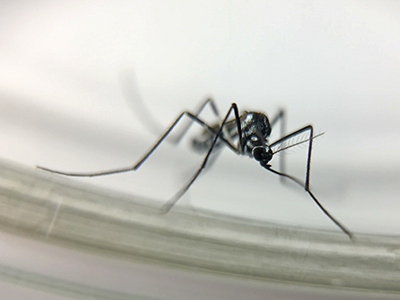 Haemagogus mosquitoes, like the Hg. leucocelaenus, are primary vectors of sylvatic yellow fever. Photo: Josué Damacena/IOC/Fiocruzi
Visually, Haemagogus and Sabethes are quite different mosquitoes. However, their habits show similarities. In the first group, the Hg. leucocelaenus have a thorax covered with dark scales with a longitudinal silver stripe on the upper part, while the Hg. janthinomys They have a thorax covered with dark scales, ranging from dark green to blue.
"To the naked eye, the Haemagogus resemble the Aedes, with the Hg. leucocelaenus are especially similar to Aedes albopictus because they have the same longitudinal stripe on the thorax. The main difference is that they don't have white stripes on their legs", says Dinair. On the other hand, the Sabethes draw attention for their metallic color, with shades of violet, purple, blue and green.
 According to Dinair, some characteristics of the biology of Haemagogus mosquitoes, such as their long lifespan, may favor the transmission of sylvatic yellow fever. Photo: Josué Damacena/IOC/Fiocruzi
Haemagogus and Sabethes are strictly wild, with Sabethes being even more selective in their dispersal. They are concentrated in places with preserved vegetation, while the Haemagogus can also be found on the periphery of the forests, in the so-called fringes of the forest, where the Sabethes usually do not venture.
O Hg. leucocelaenus it can fly a few kilometers through open spaces to reach areas of forest isolated by human action. To reproduce, these insects lay their eggs in the hollows of trees and in bamboos, in the accumulation of water formed in the internodes (the connections between sections of the stem).
Like the Aedes, the Haemagogus do not lay their eggs directly on the water surface, but on the inner wall of the breeding site close to the water surface. When the eggs are submerged, the larvae hatch and begin to develop, feeding on the organic matter present in the water, until they become pupae. About seven to ten days after the eggs hatch, the Haemagogus reach the stage of adult mosquitoes.
Sabethes, on the other hand, lay their eggs directly on the surface of the water and take about a month for the egg to develop into an adult.
Haemagogus and Sabethes insects have a lifespan considered long for mosquitoes, which may favor the spread of viruses. Laboratory observations indicate that the survival time of both exceeds months after the insects reach adulthood.
"This factor is important because, once infected, the mosquito remains a carrier and capable of transmitting the yellow fever virus throughout its life", says Dinair.
Haemagogus insects and A. aegypti share a reproductive advantage: their eggs can remain viable in the environment during periods of drought, until the rain supplies the breeding grounds with water again, contributing to the birth of the larvae.
Resistance to desiccation is lower for Haemagogus - about four months - than for A. aegypti, which can take up to a year. Even so, according to the researchers, the period is long enough to favor the continuity of the species in places with variation in the frequency of rainfall. In contrast, Sabethes eggs must come into contact with water soon after laying or they lose viability.
 Goreti points out that vaccination is essential to prevent yellow fever in areas at risk of disease transmission. Photo: Josué Damacena/IOC/Fiocruzi
Still in the reproductive aspect, the Hg. leucocelaenus have a peculiarity: only parts of their eggs hatch after the first submersion in water, while the rest remains latent, ready to hatch in subsequent submersions.
This mechanism causes a single batch of eggs to give rise to several groups of mosquitoes over time, favoring the survival of the species in the environment for a long period. It is worth remembering that, in both Haemagogus and Sabethes, the circulation of the yellow fever virus can also be favored by the fact that infected females are capable of transmitting the virus to their offspring, in a process called transovarian transmission.
The ability to fly long distances is also a differential of Hg. leucocelaenus. These insects can reach a dispersion radius of up to 6 km, far away from their breeding sites. For comparison, the A. aegypti they usually spend their entire adult lives near the places where they were born. Research indicates that in environments with high density, with houses very close together, these mosquitoes usually fly within a radius of 40 to 50 meters. In regions without barriers, such as mountains, beaches or large avenues, they reach up to 800 meters.
Haemagogus and Sabethes are daytime mosquitoes, as are A. aegypti. However, while the urban species prefers to bite in the early morning and late afternoon, wild vectors are more active during the brightest hours of the day.
"It is interesting to note that these times often coincide with human activity in the forest, both for work and for leisure", comments Goreti.
The presence of the vector is not the only necessary factor for the occurrence of cases of yellow fever. For the disease to spread, there must also be viruses in circulation and susceptible individuals who can be infected.
Considering this tripod, records of yellow fever in wild areas tend to be seasonal, with larger outbreaks occurring at intervals of five to ten years. Generally, cases occur between December and May, rainy months in much of Brazil, which favors the proliferation of vectors. In addition, although there are records of the disease annually, larger-scale epizootics are observed at intervals of five to ten years.
This is because, after an outbreak, most infected primates die and those that survive acquire immunity for life. With this, the circulation of the virus becomes limited by the absence of susceptible individuals and it only grows back as the number of young monkeys, who have not had contact with the disease, increases.
Table with the characteristics of each insect (click here to enlarge)

"When a major epizootic occurs, the risk of human cases occurring increases, as the circulation of the virus becomes more intense. However, it is important to highlight that, unlike animals, people have an effective means of preventing themselves: the vaccine", emphasizes Dinair.
"Fight the Aedes aegypti it is essential to reduce the risk of reintroducing the urban cycle of yellow fever, as well as to face dengue, Zika and chikungunya", says researcher Goreti Freitas, noting that eliminating breeding sites is one of the main ways to combat the vector.
"Unlike wild species, which lay their eggs in tree holes, the A. aegypti prefers artificial breeding grounds, common in the home environment. Therefore, it is necessary to seal the water tanks, put a screen on the drains and properly dispose of objects that can accumulate water", she guides.
Data from the Ministry of Health show that the country accounts for, from July 2017 to February 2018, 237 deaths from yellow fever, with 723 confirmed cases and 785 under investigation.
So far, all notifications are associated with the sylvatic cycle of the disease, affecting people who contracted the virus in or near forest areas. According to the folder, cases of infection in urban areas have not occurred in Brazil since 1942. One of the key differences between the two cycles of infection is in the mosquitoes that transmit the yellow fever virus in each environment, as explained by researchers from the Oswaldo Cruz Institute (IOC/Fiocruz).
While in forests insects of the genera Haemagogus and Sabethes spread the disease, in cities, the Aedes aegypti, vector of dengue, Zika and chikungunya, has transmission potential. In laboratory tests, the ability of Aedes mosquitoes from Rio de Janeiro, Manaus and Goiânia to transmit strains of the virus that circulate in Brazil and Africa was proven.
Experts emphasize the importance of preventive measures to avoid the possibility of re-urbanization of the disease.
"Haemagogus and Sabethes mosquitoes live in the treetops. For this reason, the preferred target of their bites are monkeys, which share the same habitat", reports Dinair Couto, a researcher at the Laboratory of Mosquitoes Transmitting Hematozoa.
Thus, in the sylvatic cycle of yellow fever, virus circulation is maintained by the interaction between vectors and primates, which are the main hosts and amplifiers of the virus: it is from the bite of infected primates that more mosquitoes can contract the virus.
South American simians are very sensitive to the yellow fever virus. They get sick similarly to humans and often die. The death of monkeys in a certain area is one of the main indications of the circulation of the virus in the forest.
"In this cycle, human infection occurs accidentally. When entering or approaching a forest area where there is epizootic [mortality of monkeys], unvaccinated people can contract the infection through bites of infected Haemagogus or Sabethes mosquitoes, which they eventually descend from the treetops to the ground. Without immunity to the disease, they will be infected", adds Maria Goreti Freitas, a researcher at the same Laboratory.
Different species of mosquitoes of the genera Haemagogus and Sabethes can transmit yellow fever in wild environments. In Brazil, the most frequent are Haemagogus janthinomys e Haemagogus leucocelaenus, insects considered primary vectors of the wild form of the disease, since their genetic, biological and behavioral characteristics are favorable for transmission, making them capable of triggering and maintaining the circulation of the virus.
Among the species of the genus Sabethes, the most common are Sabethes chloropterus e Sabethes albiprivus, mosquitoes considered secondary vectors of the virus, as they are not capable of sustaining viral circulation in isolation, but can contribute to its maintenance.
The two genera of insects can be found in forests from north to south of the country.
Haemagogus mosquitoes, like the Hg. leucocelaenus, are primary vectors of sylvatic yellow fever. Photo: Josué Damacena/IOC/Fiocruzi
Visually, Haemagogus and Sabethes are quite different mosquitoes. However, their habits show similarities. In the first group, the Hg. leucocelaenus have a thorax covered with dark scales with a longitudinal silver stripe on the upper part, while the Hg. janthinomys They have a thorax covered with dark scales, ranging from dark green to blue.
"To the naked eye, the Haemagogus resemble the Aedes, with the Hg. leucocelaenus are especially similar to Aedes albopictus because they have the same longitudinal stripe on the thorax. The main difference is that they don't have white stripes on their legs", says Dinair. On the other hand, the Sabethes draw attention for their metallic color, with shades of violet, purple, blue and green.
According to Dinair, some characteristics of the biology of Haemagogus mosquitoes, such as their long lifespan, may favor the transmission of sylvatic yellow fever. Photo: Josué Damacena/IOC/Fiocruzi
Haemagogus and Sabethes are strictly wild, with Sabethes being even more selective in their dispersal. They are concentrated in places with preserved vegetation, while the Haemagogus can also be found on the periphery of the forests, in the so-called fringes of the forest, where the Sabethes usually do not venture.
O Hg. leucocelaenus it can fly a few kilometers through open spaces to reach areas of forest isolated by human action. To reproduce, these insects lay their eggs in the hollows of trees and in bamboos, in the accumulation of water formed in the internodes (the connections between sections of the stem).
Like the Aedes, the Haemagogus do not lay their eggs directly on the water surface, but on the inner wall of the breeding site close to the water surface. When the eggs are submerged, the larvae hatch and begin to develop, feeding on the organic matter present in the water, until they become pupae. About seven to ten days after the eggs hatch, the Haemagogus reach the stage of adult mosquitoes.
Sabethes, on the other hand, lay their eggs directly on the surface of the water and take about a month for the egg to develop into an adult.
Haemagogus and Sabethes insects have a lifespan considered long for mosquitoes, which may favor the spread of viruses. Laboratory observations indicate that the survival time of both exceeds months after the insects reach adulthood.
"This factor is important because, once infected, the mosquito remains a carrier and capable of transmitting the yellow fever virus throughout its life", says Dinair.
Haemagogus insects and A. aegypti share a reproductive advantage: their eggs can remain viable in the environment during periods of drought, until the rain supplies the breeding grounds with water again, contributing to the birth of the larvae.
Resistance to desiccation is lower for Haemagogus - about four months - than for A. aegypti, which can take up to a year. Even so, according to the researchers, the period is long enough to favor the continuity of the species in places with variation in the frequency of rainfall. In contrast, Sabethes eggs must come into contact with water soon after laying or they lose viability.
Goreti points out that vaccination is essential to prevent yellow fever in areas at risk of disease transmission. Photo: Josué Damacena/IOC/Fiocruzi
Still in the reproductive aspect, the Hg. leucocelaenus have a peculiarity: only parts of their eggs hatch after the first submersion in water, while the rest remains latent, ready to hatch in subsequent submersions.
This mechanism causes a single batch of eggs to give rise to several groups of mosquitoes over time, favoring the survival of the species in the environment for a long period. It is worth remembering that, in both Haemagogus and Sabethes, the circulation of the yellow fever virus can also be favored by the fact that infected females are capable of transmitting the virus to their offspring, in a process called transovarian transmission.
The ability to fly long distances is also a differential of Hg. leucocelaenus. These insects can reach a dispersion radius of up to 6 km, far away from their breeding sites. For comparison, the A. aegypti they usually spend their entire adult lives near the places where they were born. Research indicates that in environments with high density, with houses very close together, these mosquitoes usually fly within a radius of 40 to 50 meters. In regions without barriers, such as mountains, beaches or large avenues, they reach up to 800 meters.
Haemagogus and Sabethes are daytime mosquitoes, as are A. aegypti. However, while the urban species prefers to bite in the early morning and late afternoon, wild vectors are more active during the brightest hours of the day.
"It is interesting to note that these times often coincide with human activity in the forest, both for work and for leisure", comments Goreti.
The presence of the vector is not the only necessary factor for the occurrence of cases of yellow fever. For the disease to spread, there must also be viruses in circulation and susceptible individuals who can be infected.
Considering this tripod, records of yellow fever in wild areas tend to be seasonal, with larger outbreaks occurring at intervals of five to ten years. Generally, cases occur between December and May, rainy months in much of Brazil, which favors the proliferation of vectors. In addition, although there are records of the disease annually, larger-scale epizootics are observed at intervals of five to ten years.
This is because, after an outbreak, most infected primates die and those that survive acquire immunity for life. With this, the circulation of the virus becomes limited by the absence of susceptible individuals and it only grows back as the number of young monkeys, who have not had contact with the disease, increases.
Table with the characteristics of each insect (click here to enlarge)
"When a major epizootic occurs, the risk of human cases occurring increases, as the circulation of the virus becomes more intense. However, it is important to highlight that, unlike animals, people have an effective means of preventing themselves: the vaccine", emphasizes Dinair.
"Fight the Aedes aegypti it is essential to reduce the risk of reintroducing the urban cycle of yellow fever, as well as to face dengue, Zika and chikungunya", says researcher Goreti Freitas, noting that eliminating breeding sites is one of the main ways to combat the vector.
"Unlike wild species, which lay their eggs in tree holes, the A. aegypti prefers artificial breeding grounds, common in the home environment. Therefore, it is necessary to seal the water tanks, put a screen on the drains and properly dispose of objects that can accumulate water", she guides.
The non-profit reproduction of the text is allowed as long as the source is cited (Comunicação / Instituto Oswaldo Cruz)
 |
 |
