
In another stage of its journey through Brazil, the 'Expresso Chagas 21' passed through Goiás and Minas Gerais, raising awareness and engaging communities in the fight against Chagas disease.
Developed at the Oswaldo Cruz Institute (IOC/Fiocruz), social technology takes the theme of the disease in a playful and educational format, with wagons designed to resemble the environment in which scientist Carlos Chagas worked when he discovered the infection.
Between October 29th and November 1st, the initiative was present in the city of Olhos D'água (GO) for the launch of the Goiana Association of Carriers of Chagas Disease (AGPDC).
During the event, the director of IOC and project coordinator, Tania Araujo-Jorge, participated in the Papo Local podcast, where she discussed the importance of the new association for those with the disease. She was accompanied by Liliane Siriano, a researcher at the Hospital das Clínicas of the Federal University of Goiás, and Swamy Lima Palmeira, a technical consultant for the Ministry of Health. Watch:
To promote knowledge about Chagas disease, the team distributed informational materials, including comic books, and offered rapid diagnostic tests, reinforcing the initiative's commitment to preventive health and access to information.
Then, between November 4th and 7th, Expresso Chagas 21 arrived in Caxambu (MG) to be part of the program of the 39th Annual Meeting of the Brazilian Society of Protozoology.
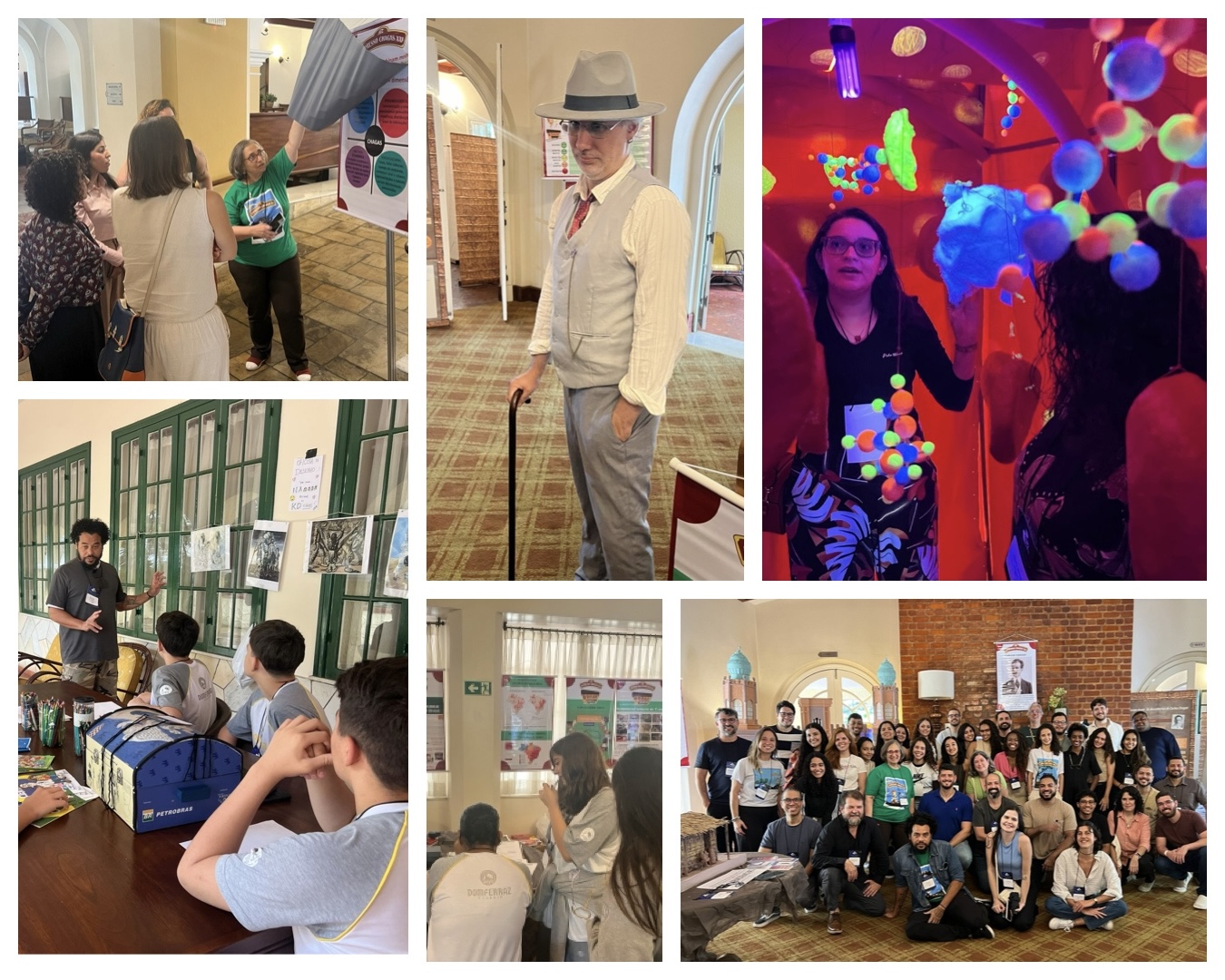
In addition to the traditional themed wagons, the initiative attracted the public's attention with parallel actions, such as the scenic model “Inside the blood”, which simulates the inside of a blood vessel, and the “Escape room: the Enigma of Lassance”, which challenges participants to solve mysteries related to the discovery of Chagas disease.
The activities were supported by volunteers previously enrolled in the special course “Expresso Chagas XXI: training of popular health agents for endemic areas”, which was offered asynchronously.
In another stage of its journey through Brazil, the 'Expresso Chagas 21' passed through Goiás and Minas Gerais, raising awareness and engaging communities in the fight against Chagas disease.
Developed at the Oswaldo Cruz Institute (IOC/Fiocruz), social technology takes the theme of the disease in a playful and educational format, with wagons designed to resemble the environment in which scientist Carlos Chagas worked when he discovered the infection.
Between October 29th and November 1st, the initiative was present in the city of Olhos D'água (GO) for the launch of the Goiana Association of Carriers of Chagas Disease (AGPDC).
During the event, the director of IOC and project coordinator, Tania Araujo-Jorge, participated in the Papo Local podcast, where she discussed the importance of the new association for those with the disease. She was accompanied by Liliane Siriano, a researcher at the Hospital das Clínicas of the Federal University of Goiás, and Swamy Lima Palmeira, a technical consultant for the Ministry of Health. Watch:
To promote knowledge about Chagas disease, the team distributed informational materials, including comic books, and offered rapid diagnostic tests, reinforcing the initiative's commitment to preventive health and access to information.
Then, between November 4th and 7th, Expresso Chagas 21 arrived in Caxambu (MG) to be part of the program of the 39th Annual Meeting of the Brazilian Society of Protozoology.
In addition to the traditional themed wagons, the initiative attracted the public's attention with parallel actions, such as the scenic model “Inside the blood”, which simulates the inside of a blood vessel, and the “Escape room: the Enigma of Lassance”, which challenges participants to solve mysteries related to the discovery of Chagas disease.
The activities were supported by volunteers previously enrolled in the special course “Expresso Chagas XXI: training of popular health agents for endemic areas”, which was offered asynchronously.
The non-profit reproduction of the text is allowed as long as the source is cited (Comunicação / Instituto Oswaldo Cruz)
 |
 |
