
The second edition of the 'Manguinhos Expedition', of the Training Course for Popular Health and Surveillance Agents, promoted by the Oswaldo Cruz Institute (IOC/Fiocruz), trained young people, adults and elderly people from communities in Rio de Janeiro to combat mosquito outbreaks Aedes aegypti, transmitter of dengue, Zika and chikungunya, and disseminate information on disease control in their territories.
Residents of Manguinhos, Benfica and Complexo do Alemão participated in the initiative held from February 13 to 17, at Casa do Trabalhador, in Manguinhos.
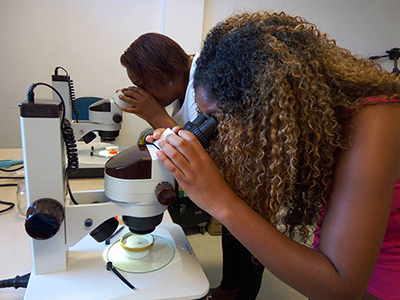 Course participants observed the A. ageypti in its different stages of life: from egg to adult mosquito. Photo: Rita Machado
"Aedes control depends on the population's engagement. On the one hand, many breeding sites are found in the domestic environment. On the other, there are important issues related to public authorities, such as water supply and regular garbage collection. Information is essential to change this reality, and public health and surveillance agents are multipliers, working to publicize actions that any citizen can take and to empower communities in their demands with public authorities", highlighted Luciana Garzoni, researcher at the Laboratory of Innovations in Therapies, Education and Bioproducts of the IOC, who coordinated the activities together with Tania Araújo Jorge, head of the same Laboratory, as well as Ricardo Malheiros, a doctoral student in the Postgraduate Program in Teaching in BiocScience and Health IOC.
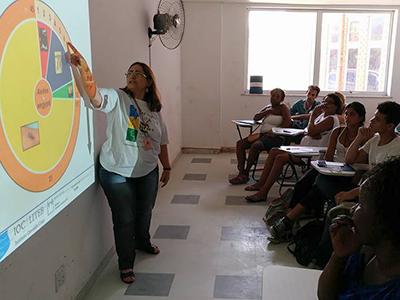 Using the 'cienciarte' method, the classes addressed the characteristics of the vector and diseases, among other issues. Photo: Rita Machado
Using the 'cienciarte' methodology, which works with the interface between science and art, promoting creativity and innovation through the integration of scientific and artistic methods of understanding and transforming the world, the course addressed important aspects for combating diseases.
In workshops, theoretical classes and practical activities, characteristics of the vector and the diseases, environmental and social determinants for the maintenance of Aedes in the Manguinhos territory, the role of the media in communication related to the theme and community audiovisual production in health, among other topics, were discussed.
In addition to observing Aedes in its different life stages, from the larva to the adult insect, the students carried out a mapping of possible mosquito outbreaks in Manguinhos, using as a tool an application developed by the Sergio Arouca National School of Public Health (Ensp/Fiocruz).
Participants also created a weekly checklist containing possible domestic breeding sites for Aedes. As a basis, the informative material from the 10 Minutes Against Aedes project, prepared by researchers and communication professionals from IOC.
The production of short films based on the course's audiovisual recording and a workshop on dialogic musical language were also part of the program.
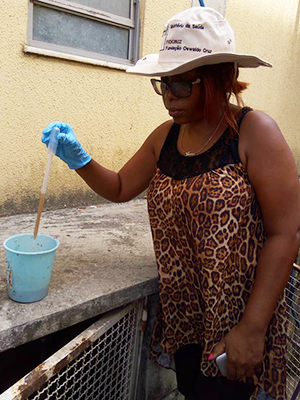 The search for possible mosquito breeding sites in Manguinhos and the collection of samples for analysis were among the activities carried out. Photo: Rita Machado
Multiplication of learning
Manguinhos resident Sílvia de Souza Cardoso, 18, said that the activities drew her attention to the importance of the population's role in combating diseases.
"During the course, we found many possible hotspots in the community, where we collected stagnant water and observed the presence of mosquito larvae. This activity made me pay even more attention to this public health problem. I will quickly remove any dangerous objects from the environment," said the young woman.
Also a resident of the community, Jonathan Vieira da Silva, 19, considered that the integration between science and art made the content more attractive, which is important for mobilization.
"Before the course, I had a lot of bottles in my backyard that would collect water when it rained. With the classes, I learned about this danger and I think I can also contribute by warning other people in the community so that they can mobilize to prevent diseases," he commented.
Teacher Angelita dos Santos Pereira, 45, also highlighted her desire to spread learning.
"For example, I didn't know that mosquito eggs can survive for up to a year in a dry environment. That's why it's not enough to just dump the accumulated water; you need to wash the pots with a sponge and detergent. As a teacher, I can bring this information to the children," she highlighted. She lives in São João de Meriti, in Baixada Fluminense, and works in Manguinhos.
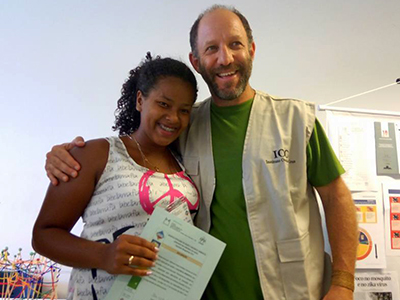 Sílvia de Souza Cardoso received the course certificate and assessed that the activity drew her attention to combating Aedes breeding grounds. Photo: Rita Machado
The course was supported by the Manguinhos Intersectoral Management Council, the Sergio Arouca National School of Public Health (Ensp/Fiocruz), from the Social Cooperation Coordination of Fiocruz, from the Fluminense Federal University (UFF), from the Municipal Health Department of Rio de Janeiro, from the municipal school Ciep Juscelino Kubitschek, from the Casa do Trabalhador de Manguinhos and from the newspaper Fala Manguinhos.
The team from the Laboratory of Innovations in Therapies, Teaching and Bioproducts and students from the Scientific Vocation Program at Fiocruz (Provoc) and Postgraduate Programs at IOC and UFF participated in the preparation and execution of the activities.
The second edition of the 'Manguinhos Expedition', of the Training Course for Popular Health and Surveillance Agents, promoted by the Oswaldo Cruz Institute (IOC/Fiocruz), trained young people, adults and elderly people from communities in Rio de Janeiro to combat mosquito outbreaks Aedes aegypti, transmitter of dengue, Zika and chikungunya, and disseminate information on disease control in their territories.
Residents of Manguinhos, Benfica and Complexo do Alemão participated in the initiative held from February 13 to 17, at Casa do Trabalhador, in Manguinhos.
Course participants observed the A. ageypti in its different stages of life: from egg to adult mosquito. Photo: Rita Machado
"Aedes control depends on the population's engagement. On the one hand, many breeding sites are found in the domestic environment. On the other, there are important issues related to public authorities, such as water supply and regular garbage collection. Information is essential to change this reality, and public health and surveillance agents are multipliers, working to publicize actions that any citizen can take and to empower communities in their demands with public authorities", highlighted Luciana Garzoni, researcher at the Laboratory of Innovations in Therapies, Education and Bioproducts of the IOC, who coordinated the activities together with Tania Araújo Jorge, head of the same Laboratory, as well as Ricardo Malheiros, a doctoral student in the Postgraduate Program in Teaching in BiocScience and Health IOC.
Using the 'cienciarte' method, the classes addressed the characteristics of the vector and diseases, among other issues. Photo: Rita Machado
Using the 'cienciarte' methodology, which works with the interface between science and art, promoting creativity and innovation through the integration of scientific and artistic methods of understanding and transforming the world, the course addressed important aspects for combating diseases.
In workshops, theoretical classes and practical activities, characteristics of the vector and the diseases, environmental and social determinants for the maintenance of Aedes in the Manguinhos territory, the role of the media in communication related to the theme and community audiovisual production in health, among other topics, were discussed.
In addition to observing Aedes in its different life stages, from the larva to the adult insect, the students carried out a mapping of possible mosquito outbreaks in Manguinhos, using as a tool an application developed by the Sergio Arouca National School of Public Health (Ensp/Fiocruz).
Participants also created a weekly checklist containing possible domestic breeding sites for Aedes. As a basis, the informative material from the 10 Minutes Against Aedes project, prepared by researchers and communication professionals from IOC.
The production of short films based on the course's audiovisual recording and a workshop on dialogic musical language were also part of the program.
The search for possible mosquito breeding sites in Manguinhos and the collection of samples for analysis were among the activities carried out. Photo: Rita Machado
Multiplication of learning
Manguinhos resident Sílvia de Souza Cardoso, 18, said that the activities drew her attention to the importance of the population's role in combating diseases.
"During the course, we found many possible hotspots in the community, where we collected stagnant water and observed the presence of mosquito larvae. This activity made me pay even more attention to this public health problem. I will quickly remove any dangerous objects from the environment," said the young woman.
Also a resident of the community, Jonathan Vieira da Silva, 19, considered that the integration between science and art made the content more attractive, which is important for mobilization.
"Before the course, I had a lot of bottles in my backyard that would collect water when it rained. With the classes, I learned about this danger and I think I can also contribute by warning other people in the community so that they can mobilize to prevent diseases," he commented.
Teacher Angelita dos Santos Pereira, 45, also highlighted her desire to spread learning.
"For example, I didn't know that mosquito eggs can survive for up to a year in a dry environment. That's why it's not enough to just dump the accumulated water; you need to wash the pots with a sponge and detergent. As a teacher, I can bring this information to the children," she highlighted. She lives in São João de Meriti, in Baixada Fluminense, and works in Manguinhos.
Sílvia de Souza Cardoso received the course certificate and assessed that the activity drew her attention to combating Aedes breeding grounds. Photo: Rita Machado
The course was supported by the Manguinhos Intersectoral Management Council, the Sergio Arouca National School of Public Health (Ensp/Fiocruz), from the Social Cooperation Coordination of Fiocruz, from the Fluminense Federal University (UFF), from the Municipal Health Department of Rio de Janeiro, from the municipal school Ciep Juscelino Kubitschek, from the Casa do Trabalhador de Manguinhos and from the newspaper Fala Manguinhos.
The team from the Laboratory of Innovations in Therapies, Teaching and Bioproducts and students from the Scientific Vocation Program at Fiocruz (Provoc) and Postgraduate Programs at IOC and UFF participated in the preparation and execution of the activities.
The non-profit reproduction of the text is allowed as long as the source is cited (Comunicação / Instituto Oswaldo Cruz)
 |
 |
