

 Children were dazzled by the magnified images in the microscopes. Photo: Gutemberg Brito
The gardens of Quinta da Boa Vista, a traditional leisure area in the city of Rio de Janeiro and which was once the residence of Dom Pedro II, were transformed into a large science fair last Sunday, July 16th. After three years canceled due to the Covid-19 pandemic, the event “Domingo com Ciência na Quinta” returned and hundreds of people who strolled through the park had the opportunity to interact with activities on the most varied topics.
Always active in popularizing science, researchers and students at the Oswaldo Cruz Institute (IOC/Fiocruz) promoted a series of immersive and interactive experiences. Games, experiments, workshops and exhibitions provided a stimulating environment for visitors to playfully explore the subjects worked on day-to-day on the benches of the Institute's laboratories.
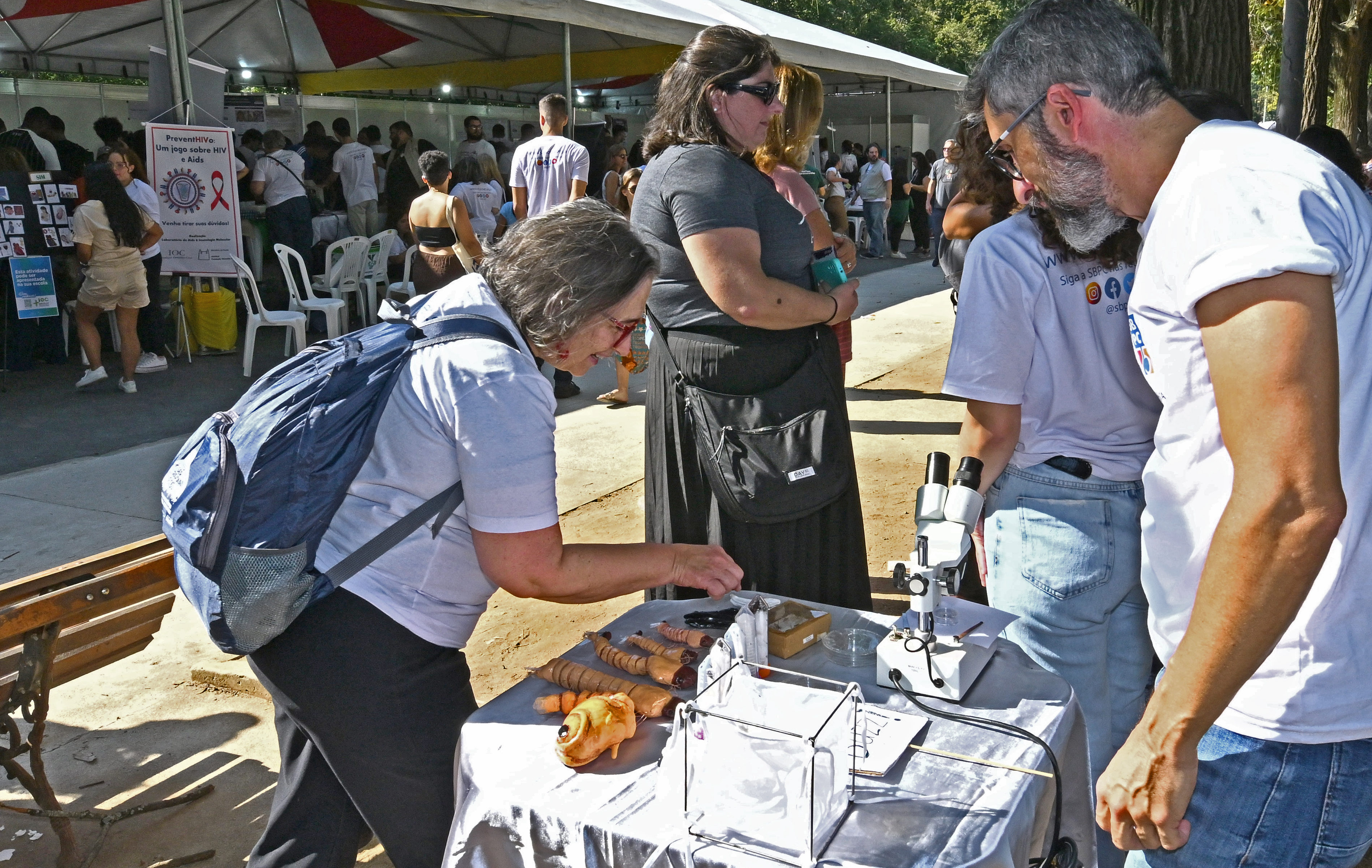 Director of IOC honors the activities of 'Sunday with Science on the Farm'. Photo: Gutemberg Brito
Promoted by the Brazilian Society for the Progress of Science (SBPC), the Science and Technology Popularization Network in Latin America and the Caribbean (RedPOP) and the Fiocruz, the initiative marked the National Day of Science and Researcher (celebrated on July 8), as well as the 75th anniversary of the SBPC and the 205th anniversary of the National Museum of the Federal University of Rio de Janeiro (UFRJ). The event was supported by the Secretary of Science and Technology of the Municipality of Rio de Janeiro and 26 state and national scientific institutions.
“It is extremely important to push the boundaries of the F campusiocruz and meet the population in the spaces it occupies. This is also a role of the scientist”, said the director of the IOC, Tania Araujo Jorge, who gave prestige to the activities.
“Quinta da Boa Vista, in addition to all its natural exuberance, is a popular, historic space and also a lot of science. It houses the National Museum, which is currently undergoing a moment of reconstruction and recovery, as well as Brazilian science”, he added.
 In the center, the vice president of Research and Biological Collections of Fiocruz, Maria de Lourdes Aguiar Oliveira, alongside the deputy directors of the Ademir Martins Institute (left), Elmo Amaral and Elizabeth Rangel. Photo: Gutemberg Brito
The expressive engagement of around 200 researchers and students from the IOC in the initiative was highlighted by the deputy director of Research, Technological Development and Innovation, Elmo Amaral.
“This event is a true celebration of knowledge. It is inspiring to see our institutional community give up the traditional Sunday rest to be here and provide unique fun and learning so that families are enchanted by science and, who knows, inspire future scientists”, he celebrated.
“Major science outreach events are returning after the Covid-19 pandemic and the IOC, if possible, will be present in all of them to show society the discoveries and scientific advances”, added the Deputy Director of Education, Information and Communication, Ademir Martins.
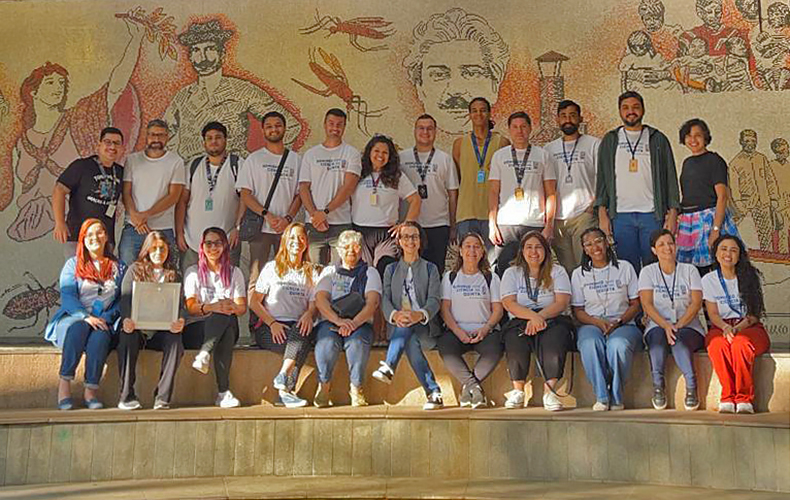 Part of the group of researchers and students from the IOC gathered on the campus of Fiocroz. Photo: reproduction
In a relaxed atmosphere full of enthusiasm, those who passed by the stands were able to learn more about the universe of microorganisms, the diversity of worms and insects, in addition to learning about diseases that are a challenge for Brazilian public health, such as dengue, AIDS, leprosy, Chagas disease and leishmaniasis [learn more below]. Many activities can be replicated in schools. Click here and check it out.
“Various items that aroused the curiosity of visitors are part of our biological collections, or are the result of work carried out in the Institute's outpatient clinics and reference laboratories, which provide a great service to the population. It was an opportunity to remind society that we do research, but we are also here to serve it”, pointed out Elizabeth Rangel, deputy director of Reference Laboratories, Outpatient Clinics and Biological Collections at the IOC.
Mosquitoes and flies were the subject of activities that sought to clarify myths and truths about these insects. The public was able to know the differences between the mosquito and the Aedes aegypti, vector of dengue, Zika and Chikungunya, and learn more about the life cycle, habits and ways of preventing diseases.
The indiscriminate use of insecticides was also discussed, highlighting that this practice can contribute to the emergence of mosquitoes resistant to chemical control.
The life cycle of flies captured the public's attention, especially as it revealed the process of infestation of the larvae in the skin, causing a disease called myiasis.
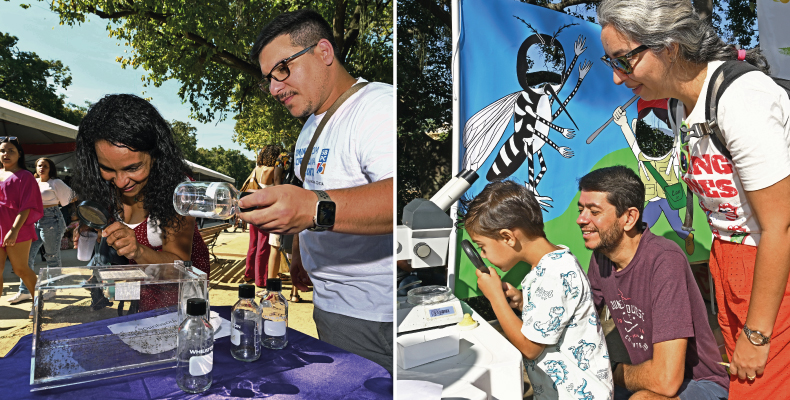 Activities attracted audiences of all ages. Photo: Gutemberg Brito
The concepts of nanotechnology were also worked on in a very didactic and interactive way. The public was able to see how science at the nanometric scale gives life to different products used in everyday life, such as cosmetics, clothing, vaccines, medicines and much more.
With a model of the respiratory system, the treatment of chronic lung diseases through nanotechnology was also discussed. It was also possible to observe lung tissues through the lenses of microscopes and participate in a quiz.
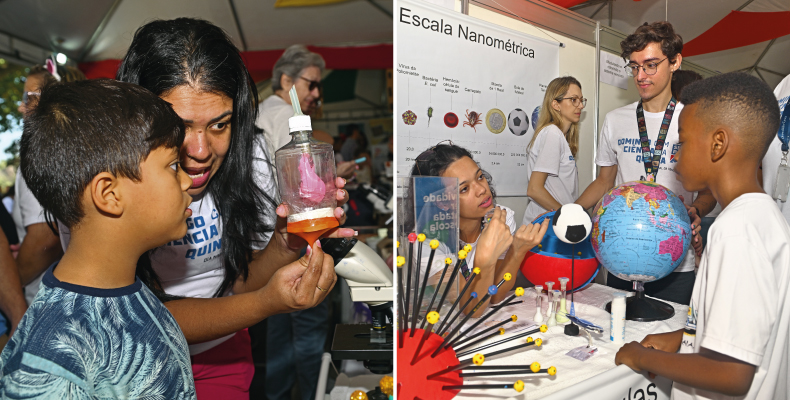 Creativity was a hallmark of the participation of IOC. Photo: Gutenberg Brito
In an experiment on hand washing, it was possible to learn the correct form of hygiene and compare the amount of bacteria present in dirty and clean hands, highlighting the fundamental role of hygiene in preventing infections.
The use of antibiotics was the motto of another action. An interactive approach provided a better understanding of the role of microorganisms and the need for awareness of this type of medicine.
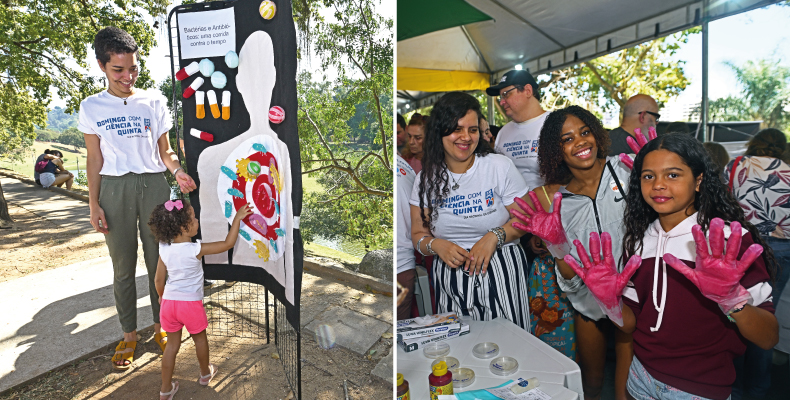 The diversity of dynamics made scientific themes even more fun. Photos: Gutemberg Brito
In addition to scientific advances and games about processes developed in laboratories, the event had space for exchanging ideas and combating prejudice.
An activity on the HIV virus attracted teenagers and adults interested in clarifying doubts and updating their perceptions about this pathogen still surrounded by stigmas. An interactive dynamic with cards tested knowledge about the ways in which the virus is transmitted, opening space for dialogues about AIDS and helping the public to understand the disease and how to prevent it.
 Playing cards opened the door to the debate on HIV transmission. Photo: Gutemberg Brito
Leprosy was also discussed. Despite being one of the oldest diseases of humanity, it still carries many stereotypes. Information about treatment and prevention were covered.
Combating the spread of false news about vaccines, a board game challenged the public to identify the veracity of information.
Anatomy knowledge was tested in a board game and a memory game.
The feeling of being a researcher for a day was explored in activities that took to the gardens of Quinta da Boa Vista some experiments carried out in laboratories, field work and innovation development.
Participants explored the field of molecular biology by extracting DNA from strawberries using only common materials found at home.
 Participants discovered that it is possible to do science at home. Photo: Gutemberg Brito
The public was also able to carry out an experiment that detects the presence of proteins in food. The activity showed the importance of a protein diet for immunity.
Another dynamic involved a sandbox with buried artificial fossils so that the public could learn more about paleoparasitology — an area that researches the evolution of diseases and parasites throughout the evolutionary history of the human host.
A computer game awakened the human inventive spirit while showing that it was possible to develop innovations in an easy and accessible way.
In another activity, it was possible to explore the brain's reaction to sensory stimuli, in addition to stimulating memory.
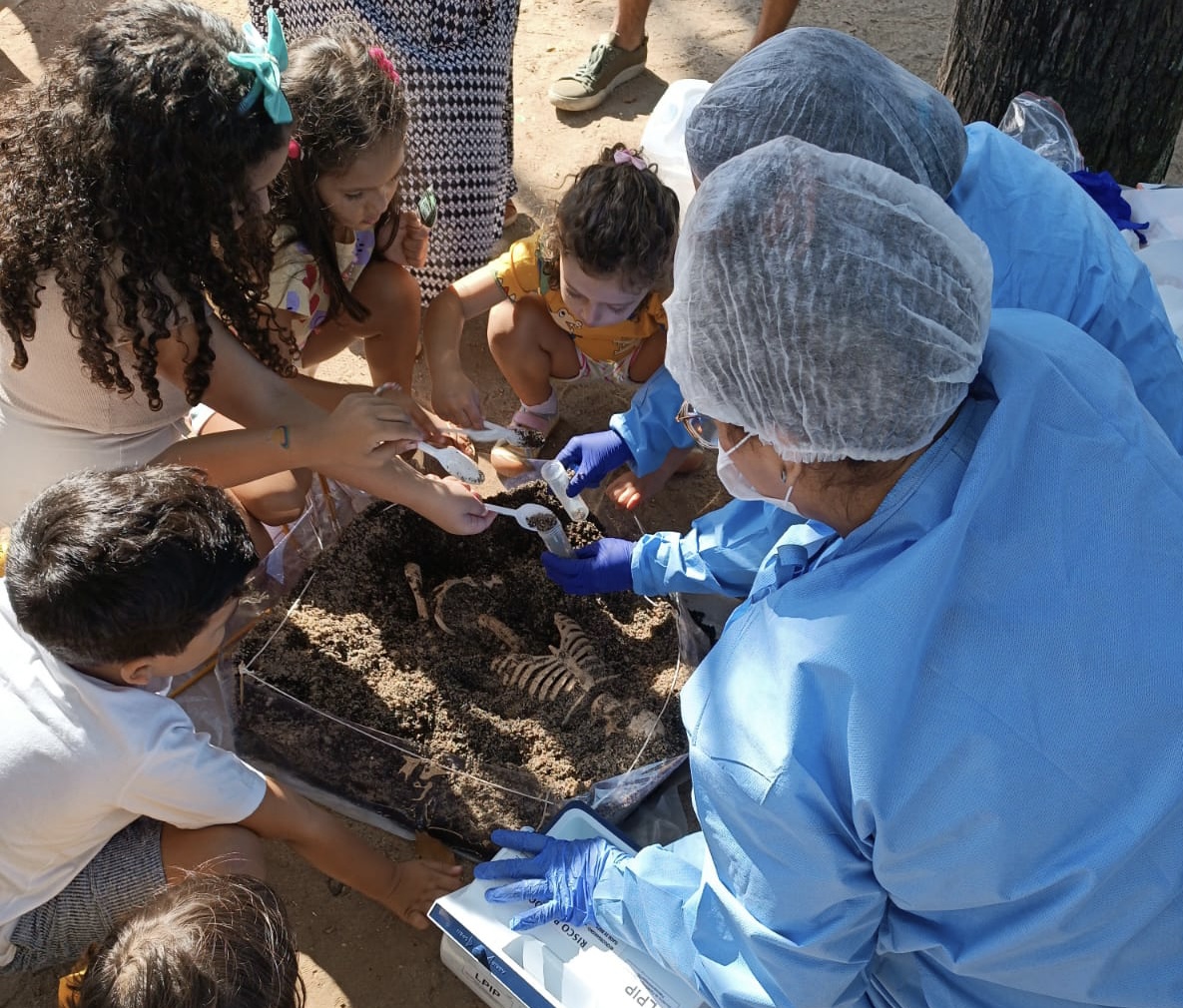 Moment of excavation was one of the children's favorites. Photo: Lorrayne Brito (LPIP/IOC)
Diseases that receive little investment from the pharmaceutical industries, mainly because they affect low-income populations, were the subject of several presentations.
Phlebotomines, vectors of leishmaniasis, triatomines, popularly known as 'kissing bugs' and vectors of Chagas disease, and snails, which transmit schistosomiasis, could be seen up close by the public, who also received explanations about the disease transmission cycles. Mollusks, known as African snails, which transmit eosinophilic meningitis, were also presented.
Another attraction that drew attention was an automated and robotic system that captured images of snails, the basis of a drug discovery project for schistosomiasis.
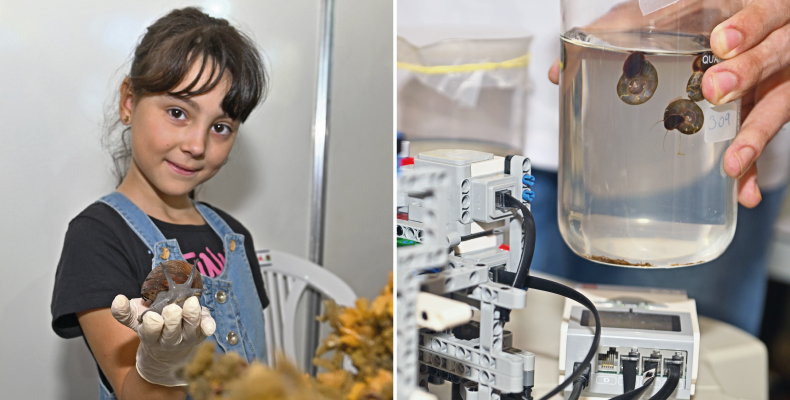 On the left, the snail was the sensation among the children. On the right, equipment made from small plastic parts impressed the audience. Photos: Gutemberg Brito
The CienciArte traveling exhibition “Expresso Chagas 21” was present at the event. The initiative addressed several aspects related to Chagas disease, from local associations that support patients to scientific discoveries carried out in laboratories and the importance of complementary integrative practices in health, such as art, music and aromatherapy.
Models addressed species of bed bugs known as "bed bugs", responsible for causing allergies. The exhibition reinforced the importance of being aware of possible infestations of these insects on sofas and beds.
Another expository activity showed worms of importance to public health and small mammals that are parasitized by these beings.
Children were dazzled by the magnified images in the microscopes. Photo: Gutemberg Brito
The gardens of Quinta da Boa Vista, a traditional leisure area in the city of Rio de Janeiro and which was once the residence of Dom Pedro II, were transformed into a large science fair last Sunday, July 16th. After three years canceled due to the Covid-19 pandemic, the event “Domingo com Ciência na Quinta” returned and hundreds of people who strolled through the park had the opportunity to interact with activities on the most varied topics.
Always active in popularizing science, researchers and students at the Oswaldo Cruz Institute (IOC/Fiocruz) promoted a series of immersive and interactive experiences. Games, experiments, workshops and exhibitions provided a stimulating environment for visitors to playfully explore the subjects worked on day-to-day on the benches of the Institute's laboratories.
Director of IOC honors the activities of 'Sunday with Science on the Farm'. Photo: Gutemberg Brito
Promoted by the Brazilian Society for the Progress of Science (SBPC), the Science and Technology Popularization Network in Latin America and the Caribbean (RedPOP) and the Fiocruz, the initiative marked the National Day of Science and Researcher (celebrated on July 8), as well as the 75th anniversary of the SBPC and the 205th anniversary of the National Museum of the Federal University of Rio de Janeiro (UFRJ). The event was supported by the Secretary of Science and Technology of the Municipality of Rio de Janeiro and 26 state and national scientific institutions.
“It is extremely important to push the boundaries of the F campusiocruz and meet the population in the spaces it occupies. This is also a role of the scientist”, said the director of the IOC, Tania Araujo Jorge, who gave prestige to the activities.
“Quinta da Boa Vista, in addition to all its natural exuberance, is a popular, historic space and also a lot of science. It houses the National Museum, which is currently undergoing a moment of reconstruction and recovery, as well as Brazilian science”, he added.
In the center, the vice president of Research and Biological Collections of Fiocruz, Maria de Lourdes Aguiar Oliveira, alongside the deputy directors of the Ademir Martins Institute (left), Elmo Amaral and Elizabeth Rangel. Photo: Gutemberg Brito
The expressive engagement of around 200 researchers and students from the IOC in the initiative was highlighted by the deputy director of Research, Technological Development and Innovation, Elmo Amaral.
“This event is a true celebration of knowledge. It is inspiring to see our institutional community give up the traditional Sunday rest to be here and provide unique fun and learning so that families are enchanted by science and, who knows, inspire future scientists”, he celebrated.
“Major science outreach events are returning after the Covid-19 pandemic and the IOC, if possible, will be present in all of them to show society the discoveries and scientific advances”, added the Deputy Director of Education, Information and Communication, Ademir Martins.
Part of the group of researchers and students from the IOC gathered on the campus of Fiocroz. Photo: reproduction
In a relaxed atmosphere full of enthusiasm, those who passed by the stands were able to learn more about the universe of microorganisms, the diversity of worms and insects, in addition to learning about diseases that are a challenge for Brazilian public health, such as dengue, AIDS, leprosy, Chagas disease and leishmaniasis [learn more below]. Many activities can be replicated in schools. Click here and check it out.
“Various items that aroused the curiosity of visitors are part of our biological collections, or are the result of work carried out in the Institute's outpatient clinics and reference laboratories, which provide a great service to the population. It was an opportunity to remind society that we do research, but we are also here to serve it”, pointed out Elizabeth Rangel, deputy director of Reference Laboratories, Outpatient Clinics and Biological Collections at the IOC.
Mosquitoes and flies were the subject of activities that sought to clarify myths and truths about these insects. The public was able to know the differences between the mosquito and the Aedes aegypti, vector of dengue, Zika and Chikungunya, and learn more about the life cycle, habits and ways of preventing diseases.
The indiscriminate use of insecticides was also discussed, highlighting that this practice can contribute to the emergence of mosquitoes resistant to chemical control.
The life cycle of flies captured the public's attention, especially as it revealed the process of infestation of the larvae in the skin, causing a disease called myiasis.
Activities attracted audiences of all ages. Photo: Gutemberg Brito
The concepts of nanotechnology were also worked on in a very didactic and interactive way. The public was able to see how science at the nanometric scale gives life to different products used in everyday life, such as cosmetics, clothing, vaccines, medicines and much more.
With a model of the respiratory system, the treatment of chronic lung diseases through nanotechnology was also discussed. It was also possible to observe lung tissues through the lenses of microscopes and participate in a quiz.
Creativity was a hallmark of the participation of IOC. Photo: Gutenberg Brito
In an experiment on hand washing, it was possible to learn the correct form of hygiene and compare the amount of bacteria present in dirty and clean hands, highlighting the fundamental role of hygiene in preventing infections.
The use of antibiotics was the motto of another action. An interactive approach provided a better understanding of the role of microorganisms and the need for awareness of this type of medicine.
The diversity of dynamics made scientific themes even more fun. Photos: Gutemberg Brito
In addition to scientific advances and games about processes developed in laboratories, the event had space for exchanging ideas and combating prejudice.
An activity on the HIV virus attracted teenagers and adults interested in clarifying doubts and updating their perceptions about this pathogen still surrounded by stigmas. An interactive dynamic with cards tested knowledge about the ways in which the virus is transmitted, opening space for dialogues about AIDS and helping the public to understand the disease and how to prevent it.
Playing cards opened the door to the debate on HIV transmission. Photo: Gutemberg Brito
Leprosy was also discussed. Despite being one of the oldest diseases of humanity, it still carries many stereotypes. Information about treatment and prevention were covered.
Combating the spread of false news about vaccines, a board game challenged the public to identify the veracity of information.
Anatomy knowledge was tested in a board game and a memory game.
The feeling of being a researcher for a day was explored in activities that took to the gardens of Quinta da Boa Vista some experiments carried out in laboratories, field work and innovation development.
Participants explored the field of molecular biology by extracting DNA from strawberries using only common materials found at home.
Participants discovered that it is possible to do science at home. Photo: Gutemberg Brito
The public was also able to carry out an experiment that detects the presence of proteins in food. The activity showed the importance of a protein diet for immunity.
Another dynamic involved a sandbox with buried artificial fossils so that the public could learn more about paleoparasitology — an area that researches the evolution of diseases and parasites throughout the evolutionary history of the human host.
A computer game awakened the human inventive spirit while showing that it was possible to develop innovations in an easy and accessible way.
In another activity, it was possible to explore the brain's reaction to sensory stimuli, in addition to stimulating memory.
Moment of excavation was one of the children's favorites. Photo: Lorrayne Brito (LPIP/IOC)
Diseases that receive little investment from the pharmaceutical industries, mainly because they affect low-income populations, were the subject of several presentations.
Phlebotomines, vectors of leishmaniasis, triatomines, popularly known as 'kissing bugs' and vectors of Chagas disease, and snails, which transmit schistosomiasis, could be seen up close by the public, who also received explanations about the disease transmission cycles. Mollusks, known as African snails, which transmit eosinophilic meningitis, were also presented.
Another attraction that drew attention was an automated and robotic system that captured images of snails, the basis of a drug discovery project for schistosomiasis.
On the left, the snail was the sensation among the children. On the right, equipment made from small plastic parts impressed the audience. Photos: Gutemberg Brito
The CienciArte traveling exhibition “Expresso Chagas 21” was present at the event. The initiative addressed several aspects related to Chagas disease, from local associations that support patients to scientific discoveries carried out in laboratories and the importance of complementary integrative practices in health, such as art, music and aromatherapy.
Models addressed species of bed bugs known as "bed bugs", responsible for causing allergies. The exhibition reinforced the importance of being aware of possible infestations of these insects on sofas and beds.
Another expository activity showed worms of importance to public health and small mammals that are parasitized by these beings.
The non-profit reproduction of the text is allowed as long as the source is cited (Comunicação / Instituto Oswaldo Cruz)
 |
 |
