
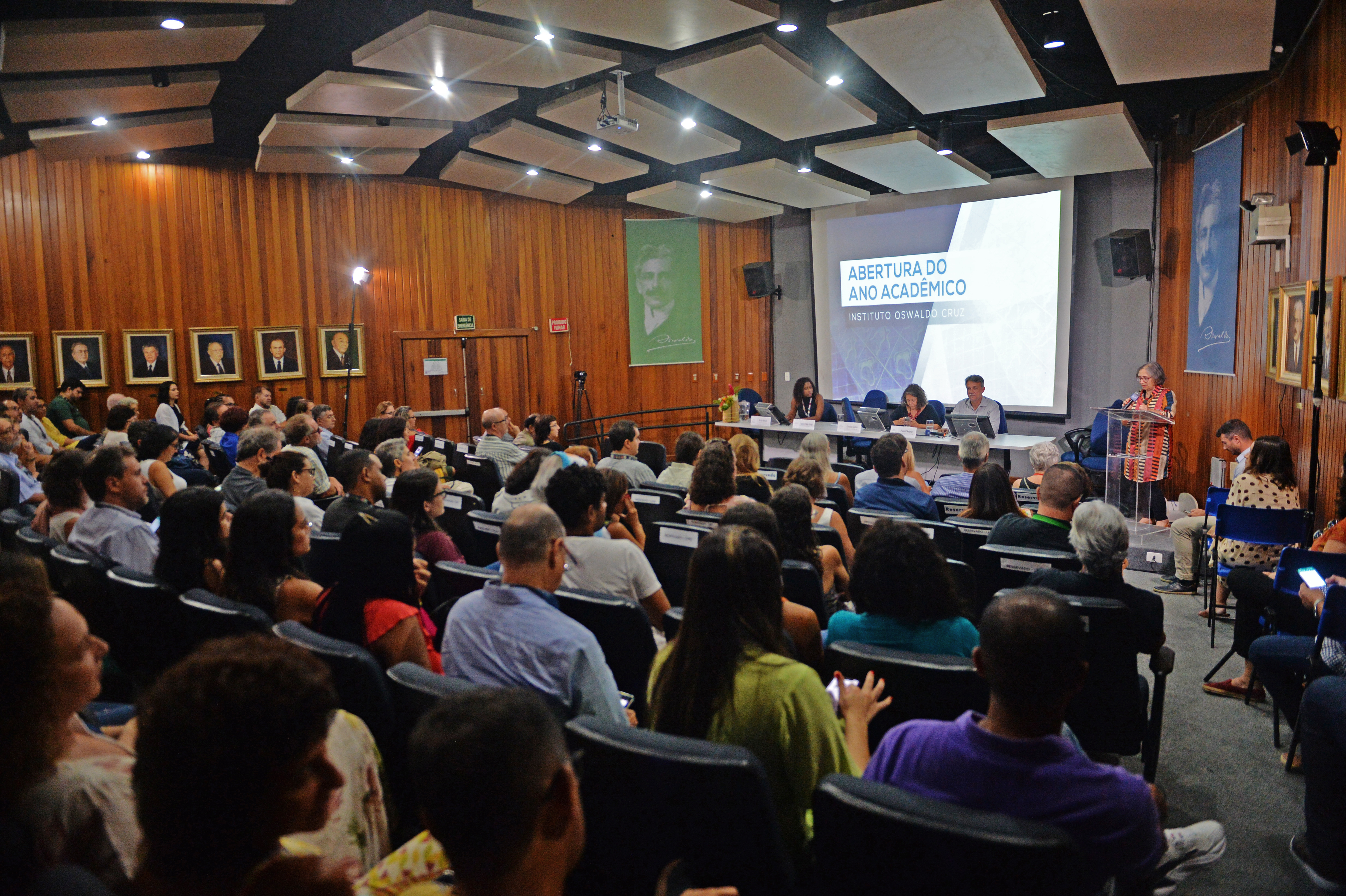
 Emmanuel Dias Auditorium, in the Arthur Neiva Pavilion, at the headquarters of Fiocruz, in Rio de Janeiro, was the stage for the Opening of the Academic Year of IOC on March 03. Photo: Gutemberg Brito
Students, advisors, researchers and other guests. With maximum capacity, the Emmanuel Dias auditorium, in the Arthur Neiva Pavilion, at the headquarters of Fiocruz, in Rio de Janeiro, was the stage for the Opening of the Academic Year of the Oswaldo Cruz Institute (IOC/Fiocruz). Held on March 03, the activity included a lecture by the president of the National Council for Scientific and Technological Development (CNPq), Ricardo Galvão. Among the highlights presented, the celebration of the recent readjustment of graduate scholarships.
The opening table of the ceremony was attended by the director of IOC, Tania Araujo-Jorge, from the Deputy Director of Education, Information and Communication at IOC, Paulo Sergio D'Andrea, the student representative of the Graduate Program in Cellular and Molecular Biology, Emily Moraes, the vice presidents of Fiocruz, Marco Krieger (Production and Innovation in Health) and Rodrigo Correa (Research and Biological Collections), and the General Coordinator of Graduate Studies at Fiocruz, Cristina Guilam.
“Seeing this auditorium full after years of restrictions imposed by the Covid-19 pandemic is very rewarding”, celebrated Tania. “It is a very special moment. After dark years, we are hopeful and certain that science will once again be valued in Brazil”, added deputy director Paulo D'Andrea.
The General Coordinator of Postgraduate Studies at F.iocruz, Cristina Guilam, drew attention to the Foundation's commitment to structuring a more democratic world from the point of view of science and technology. “AFiocruz is working as hard as he can to keep the adjustment of scholarships within his budget, as he understands the importance of the measure for the permanence of students in postgraduate programs and, consequently, for the sustainability of Teaching at the institution”, he commented.
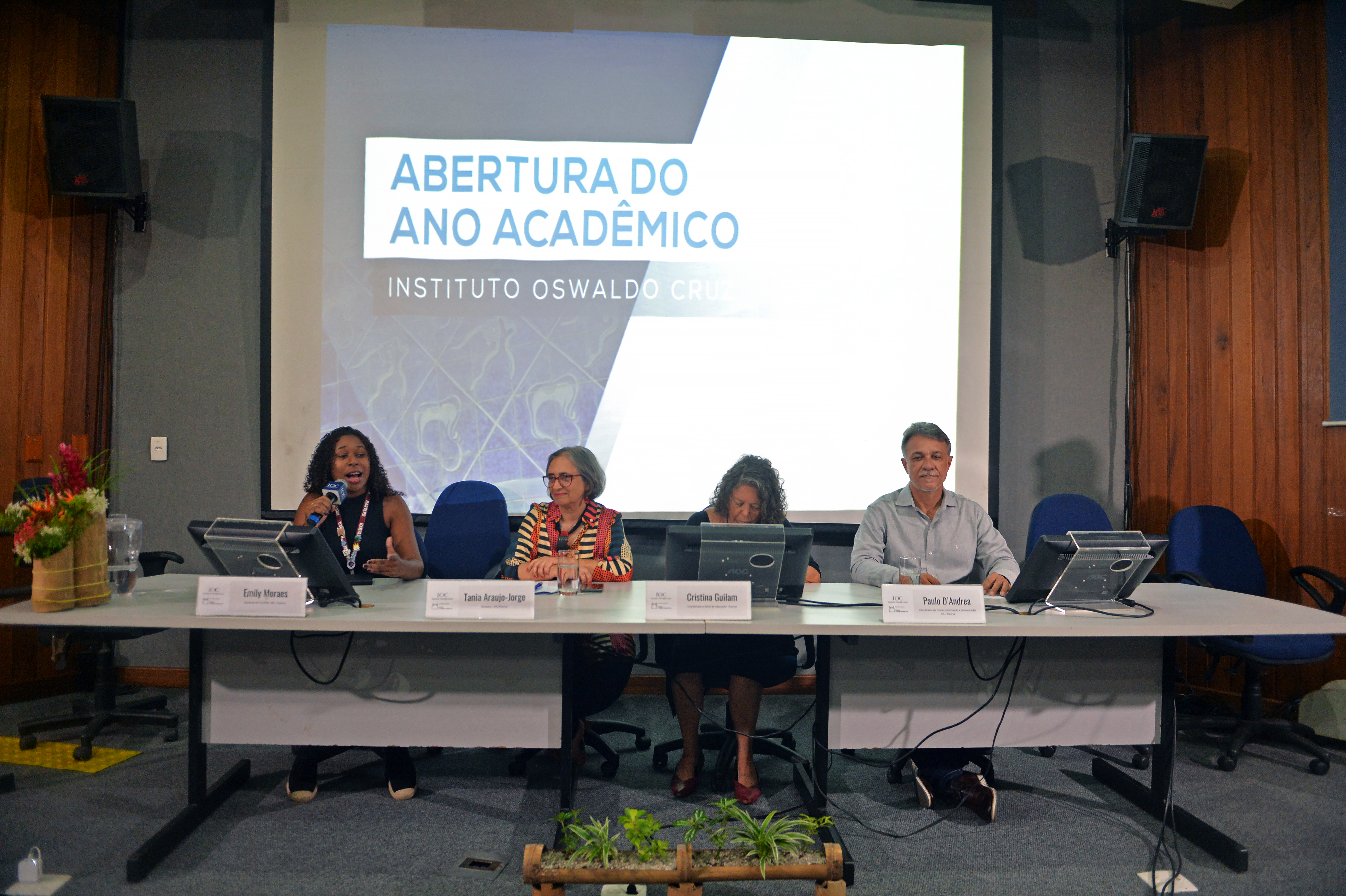 Opening panel composed by Emily Moraes, student representative of the Graduate Program in Cellular and Molecular Biology; Tania Araujo-Jorge, director of the IOC; Cristina Guilam, General Coordinator of Graduate Studies at Fiocroz; and Paulo Sergio D'Andrea, Deputy Director of Education, Information and Communication at IOC (left to right). Photo: Gutemberg Brito
Vice-presidents Rodrigo Correa and Marco Krieger highlighted the symbolic character of the ceremony. “The opening of the Academic Year of the IOC represents, firstly, the resumption of face-to-face events in the post-pandemic period. Then, the CNPq president's lecture in the program symbolizes the return to the appreciation of science. We are proud to participate in this moment”, they declared.
PhD student at the Graduate Program in Cellular and Molecular Biology at the IOC, Emily Moraes participated in the opening panel representing all the Institute's students. “This is the first time I've seen so many of you in person since I entered the IOC in the midst of the Covid-19 pandemic. I want to welcome new students and say that student representation is available to provide support and assistance to anyone who needs it. Let's celebrate the scholarship increase and continue the fight for better teaching conditions”, he stressed.
Science, Innovation and Citizenship
Invited to give the lecture 'Science, Innovation and Citizenship', the president of CNPq, Ricardo Galvão, highlighted the importance of basic science for the sustainable development of a country; debated the denialist truculence that has surrounded Brazil in recent years, responding, above all, to the question of 'why is science losing credibility with society and the protagonism in the formulation of public policies?'; and, finally, he spoke of the readjustment of graduate scholarships and pointed out the difficulties faced by scientific institutions in transferring innovative technology to the market.
“If we look at the CNPq budget since 1996, we will see that there was a large increase until 2014 in the volume of scholarships offered. Currently, we spend 90% of our resources on scholarships and 10% on research laboratories. This percentage is ridiculous. We are thinking of a solution to this issue”, he commented.
Watch the video and check out all the highlights:
Possession of the Institute's Research Laboratories
The ceremony was also marked by the inauguration of the 66 Research Laboratories of the IOC accredited for the period 2023-2028. Before presenting each Laboratory in a symbolic way, the director of the Institute contextualized the gifts of the process.
“The Institute's Deliberative Council unanimously approved the new organizational composition. It is the first time that we publicly present the composition of our Research Laboratories”, he celebrated.
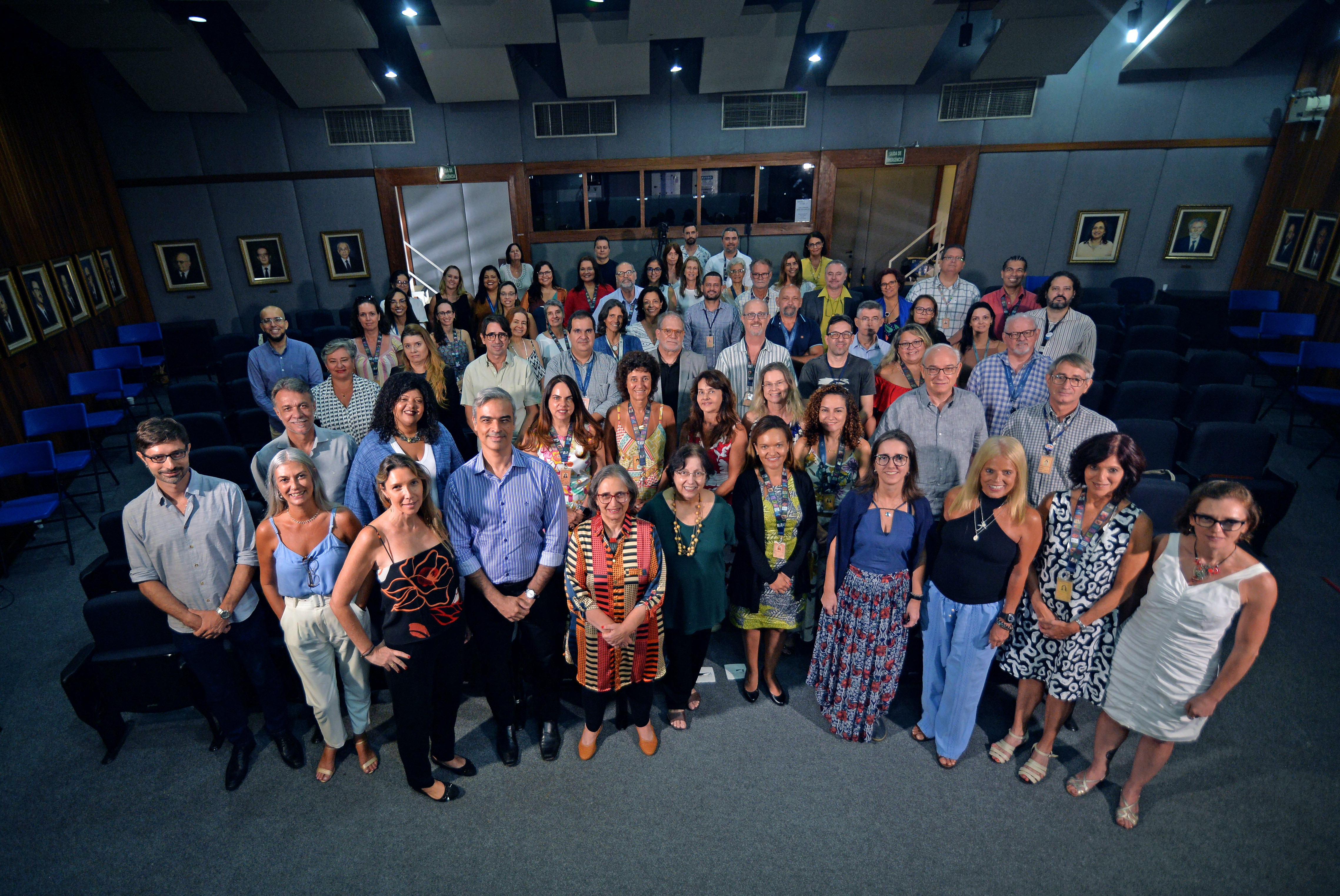 Heads and representatives of laboratories together with members of the Board during the inauguration ceremony. Photo: Gutemberg Brito
welcome to students
The welcome set the tone for the welcome session for students that ended the Institute's Academic Year Opening program. With the theme 'I'm a student @, I'm IOC', the activity included presentations by the Deputy Board of Education, Information and Communication; the Internal Commission for Valuing Interpersonal Relations and Harassment Prevention and the Student Support Center (CAD). Graduate students were also welcomed by student representatives from the programs Strict sensu.
The openness to dialogue with students was highlighted by the Deputy Director of Education, Paulo Sergio D'Andrea. Among the tips for integrating students, he drew attention to access to institutional email and the intranet, as channels for disseminating important information about the institution's day-to-day activities, events and opportunities. He also highlighted the possibility of participation of student representatives in various advisory and decision-making forums at the Institute, including the Deliberative Council and the Technical Chambers.
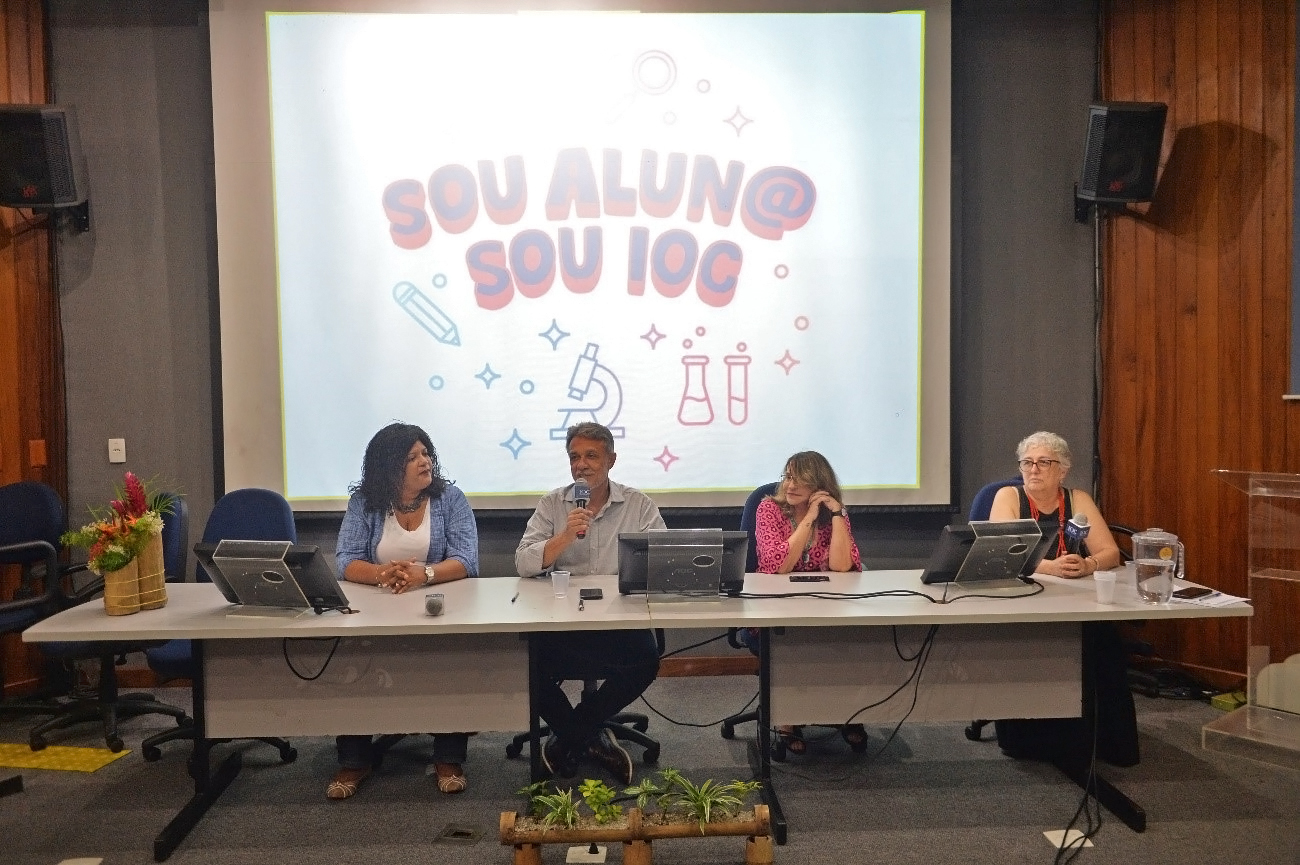 At the table, the deputy directors of Management and Teaching, the CAD coordinator and the head of the Academic Secretariat highlighted opportunities offered by the IOC and by Fioccross to students. Photo: Gutemberg Brito
“The motto 'I am a student@, I am IOC' aims to demonstrate the appreciation of the role of students in the Institute. Today is the beginning of a journey of great challenges and you will be able to count on us”, commented the head of the Academic Secretariat and advisor to the Deputy Board of Education, Information and Communication, Norma Brandão.
Possibilities of support for students were presented by the vice-director of Institutional Development and IOC, Wania Santiago, and by the coordinator of the F Student Support Centeriocruz, Etinete Gonçalves.
Coordinator of the Institute's Internal Commission for Valuing Interpersonal Relations and Harassment Prevention, Wania spoke about the work developed to encourage fair and healthy work and teaching relationships. She also pointed out ways to report situations of harassment, such as the 'Acolhe IOC'.
“In addition to dealing with harassment, the Commission seeks to focus on valuing people. Healthy relationships can minimize or inhibit these occurrences,” added Wania.
The offer of Integrative and Complementary Health Practices (PICS) at the Institute was also presented as an initiative to value people. The deputy director emphasized that, like all members of the community of IOC, students can search for activities offered, such as acupuncture, auriculotherapy, meditation, reiki, flower therapy and yoga.
Linked to the Vice-Presidency of Education, Information and Communication (VPEIC/Fiocruz), the CAD offers shelter to students, including support in situations of psychological, academic or social vulnerability. According to Etinete, in addition to individual assistance, the Center seeks to promote debates on topics of interest to students.
“We have been holding online debates in partnership with the APGs [Postgraduate Students Associations] of Fiocfrom all over Brazil on issues such as employability and mental health. We also promoted the 'conversation screens' activity, an online meeting mediated by professionals to exchange experiences”, mentioned the CAD coordinator.
Other initiatives highlighted by Etinete were the English language training program and the concession of permanence aid, offered by VPEIC for low-income students.
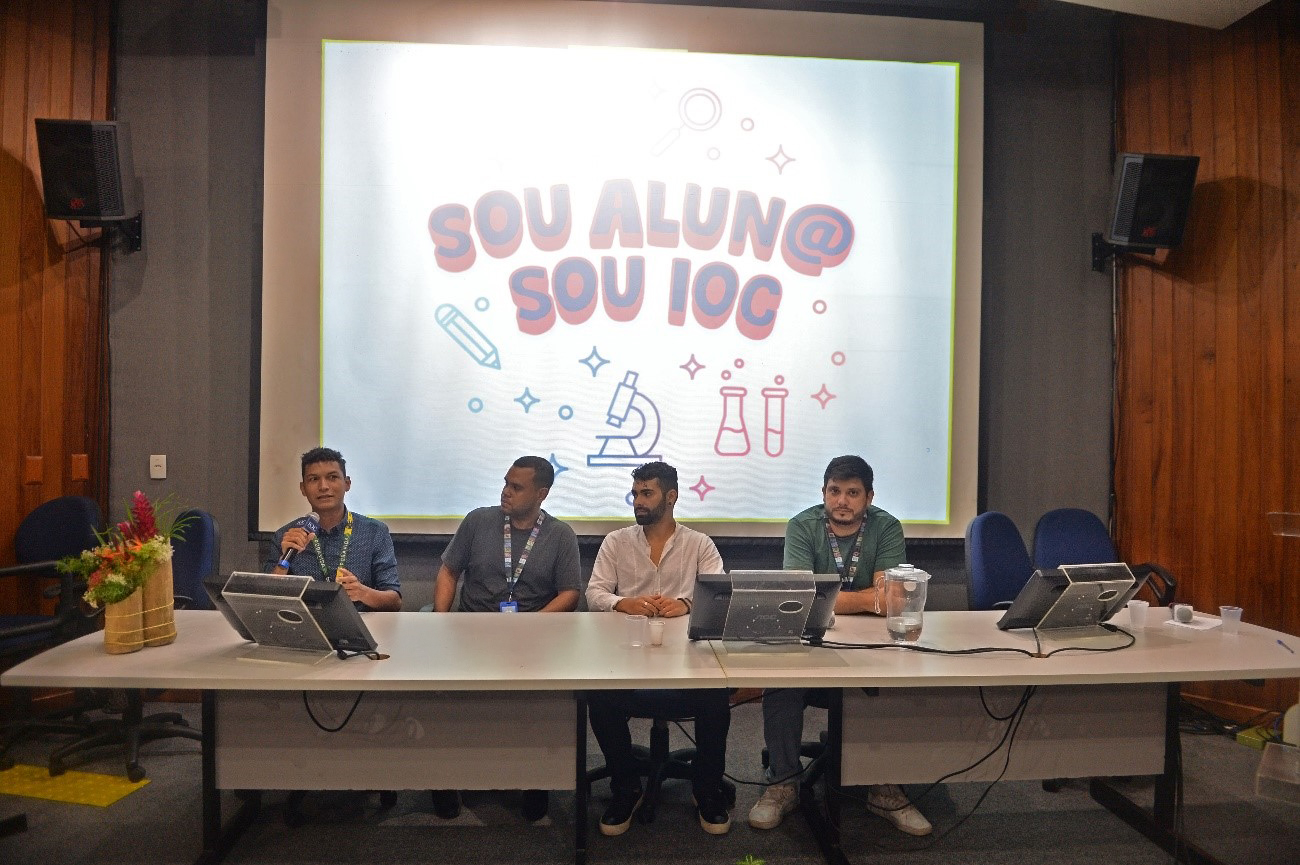 The student representatives of the programs made themselves available to support new students in graduate school. Photo: Gutemberg Brito
A table with the participation of student representatives from the graduate programs of the IOC completed the activity. Representatives from Cellular and Molecular Biology, Meydson Corrêa; Computational and System Biology; Pedro de Almeida; of Teaching in BiocScience and Health, Brenno de Barros; and from Tropical Medicine, Thiago Souza.
The representatives highlighted the importance of the partnership between the students and made themselves available to take the demands of the students to the programs.
“We are students who speak for students. We have a chair on the Graduate Commission and we are heard in the discussions”, Meydson highlighted. “We are available to support students, so that it is a peaceful journey and that everyone is happy to be here studying and researching”, added Pedro.
The students were also greeted by the director of communication of the Union of Workers of the Fiocruz (Asfoc-SN), Gutemberg Brito, who welcomed the new students and offered support to the students during their time at Fiocroz.
Emmanuel Dias Auditorium, in the Arthur Neiva Pavilion, at the headquarters of Fiocruz, in Rio de Janeiro, was the stage for the Opening of the Academic Year of IOC on March 03. Photo: Gutemberg Brito
Students, advisors, researchers and other guests. With maximum capacity, the Emmanuel Dias auditorium, in the Arthur Neiva Pavilion, at the headquarters of Fiocruz, in Rio de Janeiro, was the stage for the Opening of the Academic Year of the Oswaldo Cruz Institute (IOC/Fiocruz). Held on March 03, the activity included a lecture by the president of the National Council for Scientific and Technological Development (CNPq), Ricardo Galvão. Among the highlights presented, the celebration of the recent readjustment of graduate scholarships.
The opening table of the ceremony was attended by the director of IOC, Tania Araujo-Jorge, from the Deputy Director of Education, Information and Communication at IOC, Paulo Sergio D'Andrea, the student representative of the Graduate Program in Cellular and Molecular Biology, Emily Moraes, the vice presidents of Fiocruz, Marco Krieger (Production and Innovation in Health) and Rodrigo Correa (Research and Biological Collections), and the General Coordinator of Graduate Studies at Fiocruz, Cristina Guilam.
“Seeing this auditorium full after years of restrictions imposed by the Covid-19 pandemic is very rewarding”, celebrated Tania. “It is a very special moment. After dark years, we are hopeful and certain that science will once again be valued in Brazil”, added deputy director Paulo D'Andrea.
The General Coordinator of Postgraduate Studies at F.iocruz, Cristina Guilam, drew attention to the Foundation's commitment to structuring a more democratic world from the point of view of science and technology. “AFiocruz is working as hard as he can to keep the adjustment of scholarships within his budget, as he understands the importance of the measure for the permanence of students in postgraduate programs and, consequently, for the sustainability of Teaching at the institution”, he commented.
Opening panel composed by Emily Moraes, student representative of the Graduate Program in Cellular and Molecular Biology; Tania Araujo-Jorge, director of the IOC; Cristina Guilam, General Coordinator of Graduate Studies at Fiocroz; and Paulo Sergio D'Andrea, Deputy Director of Education, Information and Communication at IOC (left to right). Photo: Gutemberg Brito
Vice-presidents Rodrigo Correa and Marco Krieger highlighted the symbolic character of the ceremony. “The opening of the Academic Year of the IOC represents, firstly, the resumption of face-to-face events in the post-pandemic period. Then, the CNPq president's lecture in the program symbolizes the return to the appreciation of science. We are proud to participate in this moment”, they declared.
PhD student at the Graduate Program in Cellular and Molecular Biology at the IOC, Emily Moraes participated in the opening panel representing all the Institute's students. “This is the first time I've seen so many of you in person since I entered the IOC in the midst of the Covid-19 pandemic. I want to welcome new students and say that student representation is available to provide support and assistance to anyone who needs it. Let's celebrate the scholarship increase and continue the fight for better teaching conditions”, he stressed.
Science, Innovation and Citizenship
Invited to give the lecture 'Science, Innovation and Citizenship', the president of CNPq, Ricardo Galvão, highlighted the importance of basic science for the sustainable development of a country; debated the denialist truculence that has surrounded Brazil in recent years, responding, above all, to the question of 'why is science losing credibility with society and the protagonism in the formulation of public policies?'; and, finally, he spoke of the readjustment of graduate scholarships and pointed out the difficulties faced by scientific institutions in transferring innovative technology to the market.
“If we look at the CNPq budget since 1996, we will see that there was a large increase until 2014 in the volume of scholarships offered. Currently, we spend 90% of our resources on scholarships and 10% on research laboratories. This percentage is ridiculous. We are thinking of a solution to this issue”, he commented.
Watch the video and check out all the highlights:
Possession of the Institute's Research Laboratories
The ceremony was also marked by the inauguration of the 66 Research Laboratories of the IOC accredited for the period 2023-2028. Before presenting each Laboratory in a symbolic way, the director of the Institute contextualized the gifts of the process.
“The Institute's Deliberative Council unanimously approved the new organizational composition. It is the first time that we publicly present the composition of our Research Laboratories”, he celebrated.
Heads and representatives of laboratories together with members of the Board during the inauguration ceremony. Photo: Gutemberg Brito
welcome to students
The welcome set the tone for the welcome session for students that ended the Institute's Academic Year Opening program. With the theme 'I'm a student @, I'm IOC', the activity included presentations by the Deputy Board of Education, Information and Communication; the Internal Commission for Valuing Interpersonal Relations and Harassment Prevention and the Student Support Center (CAD). Graduate students were also welcomed by student representatives from the programs Strict sensu.
The openness to dialogue with students was highlighted by the Deputy Director of Education, Paulo Sergio D'Andrea. Among the tips for integrating students, he drew attention to access to institutional email and the intranet, as channels for disseminating important information about the institution's day-to-day activities, events and opportunities. He also highlighted the possibility of participation of student representatives in various advisory and decision-making forums at the Institute, including the Deliberative Council and the Technical Chambers.
At the table, the deputy directors of Management and Teaching, the CAD coordinator and the head of the Academic Secretariat highlighted opportunities offered by the IOC and by Fioccross to students. Photo: Gutemberg Brito
“The motto 'I am a student@, I am IOC' aims to demonstrate the appreciation of the role of students in the Institute. Today is the beginning of a journey of great challenges and you will be able to count on us”, commented the head of the Academic Secretariat and advisor to the Deputy Board of Education, Information and Communication, Norma Brandão.
Possibilities of support for students were presented by the vice-director of Institutional Development and IOC, Wania Santiago, and by the coordinator of the F Student Support Centeriocruz, Etinete Gonçalves.
Coordinator of the Institute's Internal Commission for Valuing Interpersonal Relations and Harassment Prevention, Wania spoke about the work developed to encourage fair and healthy work and teaching relationships. She also pointed out ways to report situations of harassment, such as the 'Acolhe IOC'.
“In addition to dealing with harassment, the Commission seeks to focus on valuing people. Healthy relationships can minimize or inhibit these occurrences,” added Wania.
The offer of Integrative and Complementary Health Practices (PICS) at the Institute was also presented as an initiative to value people. The deputy director emphasized that, like all members of the community of IOC, students can search for activities offered, such as acupuncture, auriculotherapy, meditation, reiki, flower therapy and yoga.
Linked to the Vice-Presidency of Education, Information and Communication (VPEIC/Fiocruz), the CAD offers shelter to students, including support in situations of psychological, academic or social vulnerability. According to Etinete, in addition to individual assistance, the Center seeks to promote debates on topics of interest to students.
“We have been holding online debates in partnership with the APGs [Postgraduate Students Associations] of Fiocfrom all over Brazil on issues such as employability and mental health. We also promoted the 'conversation screens' activity, an online meeting mediated by professionals to exchange experiences”, mentioned the CAD coordinator.
Other initiatives highlighted by Etinete were the English language training program and the concession of permanence aid, offered by VPEIC for low-income students.
The student representatives of the programs made themselves available to support new students in graduate school. Photo: Gutemberg Brito
A table with the participation of student representatives from the graduate programs of the IOC completed the activity. Representatives from Cellular and Molecular Biology, Meydson Corrêa; Computational and System Biology; Pedro de Almeida; of Teaching in BiocScience and Health, Brenno de Barros; and from Tropical Medicine, Thiago Souza.
The representatives highlighted the importance of the partnership between the students and made themselves available to take the demands of the students to the programs.
“We are students who speak for students. We have a chair on the Graduate Commission and we are heard in the discussions”, Meydson highlighted. “We are available to support students, so that it is a peaceful journey and that everyone is happy to be here studying and researching”, added Pedro.
The students were also greeted by the director of communication of the Union of Workers of the Fiocruz (Asfoc-SN), Gutemberg Brito, who welcomed the new students and offered support to the students during their time at Fiocroz.
The non-profit reproduction of the text is allowed as long as the source is cited (Comunicação / Instituto Oswaldo Cruz)
 |
 |


