
Created as a playful way of presenting Brazilian scientists and topics linked to tropical diseases – and also as an important warning about fake news and misinformation – the games'Caminhos de Oswaldo' and'Imune: Série Viruses' will be distributed to public schools and libraries in the Rio de Janeiro and the Federal District.
Both were developed in partnership by the Postgraduate Program in Tropical Medicine at the Oswaldo Cruz Institute (IOC/Fiocruz) and by the Multimeios sector, of the Institute of Communication and Information in Health (Icict/Fiocruz).
The project was conceived by a researcher from the Laboratory of Hantaviruses and Rickettsioses of the IOC, Elba Lemos. The two games were created by the researcher and postgraduate students in Tropical Medicine as the final work of a course. Based on the prototypes developed, the Multimeios team worked on the visual identity and adjustments to the game rules, in addition to suggesting improvements. Multimeios programmer Venicio Ribeiro coordinated the game development project in the sector.
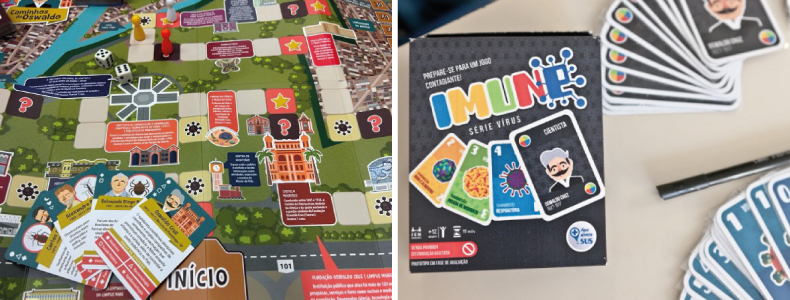 Board game 'Caminhos de Oswaldo' and card game 'Imune' contribute to scientific dissemination in a playful way. Photos: Raquel Portugal/ICICT/Fiocruzi
In total, 1.800 units were produced and will be offered in kits, including a rule manual and teaching material with comments, strategies and lesson plans, developed to help teachers make the most of games in the classroom.
The production of the circulation included resources from parliamentary amendments by senator Leila Barros (PDT-DF) and federal deputy Jandira Feghali (PCdoB-RJ).
Caminhos de Oswaldo is a board game that invites participants to experience the role of F researchersiocruz. They need to follow a path within the Foundation with the aim of accumulating (knowledge) points through tasks such as forming multidisciplinary teams and answering questions. Whoever accumulates the most points at the end of the path wins the game.
The dice indicate how many spaces each player will advance, turn by turn. On the route shown on the board there are stars, viruses and question marks. If a star falls, the participant will be entitled to draw two cards that describe the trajectories of national researchers, choose one to be part of their team and give another to an opponent. The more areas of activity the team has, the better.
If you land on the virus image, you need to draw a card from the corresponding deck. These cards can give one or two points at the end of the game, if it is information about vaccines and viruses; or no point, if it is an event, such as a pandemic.
If you land on the question mark, the letter will indicate a statement about some aspect related to viruses, and you must answer whether it is true or false. The more correct answers, the more knowledge points you accumulate at the end.
In addition to the icons that are part of the game's dynamics, the board also presents the different research centers and spaces located on the Manguinhos campus, such as the Castelo Mourisco, the Manguinhos Library and the Museum of Life, for example.
The illustrations help game participants to get to know F better.iocruz and its surroundings and become familiar with the work carried out at the institution.
‘Immune: Virus Series’ is a card game. It explores key concepts of virology: the different viruses, their forms of transmission, control and prevention. To do this, the cards are divided by color. The blue ones deal with aspects of respiratory transmission viruses. The yellow ones, those transmitted by water and food. The green ones, by vectors and animals. The red ones cover viruses transmitted sexually, through blood and through contact.
But, in addition to the cards related to the viruses themselves, there are those that represent risky behaviors, medical recommendations and prevention measures, which can benefit or harm the player who “took them”.
There are those that highlight scientists and their discoveries, such as Adolfo Lutz, Hélio Pereira and José Rodrigues Coura. And there are also fake news cards, which force the player to “buy” four other cards — that is, to go back in the game.
Created as a playful way of presenting Brazilian scientists and topics linked to tropical diseases – and also as an important warning about fake news and misinformation – the games'Caminhos de Oswaldo' and'Imune: Série Viruses' will be distributed to public schools and libraries in the Rio de Janeiro and the Federal District.
Both were developed in partnership by the Postgraduate Program in Tropical Medicine at the Oswaldo Cruz Institute (IOC/Fiocruz) and by the Multimeios sector, of the Institute of Communication and Information in Health (Icict/Fiocruz).
The project was conceived by a researcher from the Laboratory of Hantaviruses and Rickettsioses of the IOC, Elba Lemos. The two games were created by the researcher and postgraduate students in Tropical Medicine as the final work of a course. Based on the prototypes developed, the Multimeios team worked on the visual identity and adjustments to the game rules, in addition to suggesting improvements. Multimeios programmer Venicio Ribeiro coordinated the game development project in the sector.
Board game 'Caminhos de Oswaldo' and card game 'Imune' contribute to scientific dissemination in a playful way. Photos: Raquel Portugal/ICICT/Fiocruzi
In total, 1.800 units were produced and will be offered in kits, including a rule manual and teaching material with comments, strategies and lesson plans, developed to help teachers make the most of games in the classroom.
The production of the circulation included resources from parliamentary amendments by senator Leila Barros (PDT-DF) and federal deputy Jandira Feghali (PCdoB-RJ).
Caminhos de Oswaldo is a board game that invites participants to experience the role of F researchersiocruz. They need to follow a path within the Foundation with the aim of accumulating (knowledge) points through tasks such as forming multidisciplinary teams and answering questions. Whoever accumulates the most points at the end of the path wins the game.
The dice indicate how many spaces each player will advance, turn by turn. On the route shown on the board there are stars, viruses and question marks. If a star falls, the participant will be entitled to draw two cards that describe the trajectories of national researchers, choose one to be part of their team and give another to an opponent. The more areas of activity the team has, the better.
If you land on the virus image, you need to draw a card from the corresponding deck. These cards can give one or two points at the end of the game, if it is information about vaccines and viruses; or no point, if it is an event, such as a pandemic.
If you land on the question mark, the letter will indicate a statement about some aspect related to viruses, and you must answer whether it is true or false. The more correct answers, the more knowledge points you accumulate at the end.
In addition to the icons that are part of the game's dynamics, the board also presents the different research centers and spaces located on the Manguinhos campus, such as the Castelo Mourisco, the Manguinhos Library and the Museum of Life, for example.
The illustrations help game participants to get to know F better.iocruz and its surroundings and become familiar with the work carried out at the institution.
‘Immune: Virus Series’ is a card game. It explores key concepts of virology: the different viruses, their forms of transmission, control and prevention. To do this, the cards are divided by color. The blue ones deal with aspects of respiratory transmission viruses. The yellow ones, those transmitted by water and food. The green ones, by vectors and animals. The red ones cover viruses transmitted sexually, through blood and through contact.
But, in addition to the cards related to the viruses themselves, there are those that represent risky behaviors, medical recommendations and prevention measures, which can benefit or harm the player who “took them”.
There are those that highlight scientists and their discoveries, such as Adolfo Lutz, Hélio Pereira and José Rodrigues Coura. And there are also fake news cards, which force the player to “buy” four other cards — that is, to go back in the game.
The non-profit reproduction of the text is allowed as long as the source is cited (Comunicação / Instituto Oswaldo Cruz)
 |
 |
