
Target of an intense sanitary campaign undertaken by Oswaldo Cruz, urban yellow fever was eradicated from Rio de Janeiro at the beginning of the 1940th century. In Brazil, the last record of the urban cycle of the disease dates from the XNUMXs, in Acre. However, given the current public health scenario in the country, the reemergence of this form of transmission has been considered a possibility.
Present daily in the news and a challenge for researchers and managers, yellow fever was the opening theme of the Academic Year of the Oswaldo Cruz Institute (IOC/Fiocruz). Held last Friday, 17/03, the activity, which kicked off the 2017 edition of the Centro de Estudos do IOC - the institution's most traditional academic activity - was attended by the head of the Pathology Laboratory of the IOC, Marcelo Pelajo Machado, the deputy director of Technological Development at Bio-Manguinhos, Marcos da Silva Freire, and the coordinator of the Center for Research in Virology at the University of São Paulo, Luiz Tadeu Moraes Figueiredo. The historical and clinical aspects and the impacts of the disease in the country were discussed.
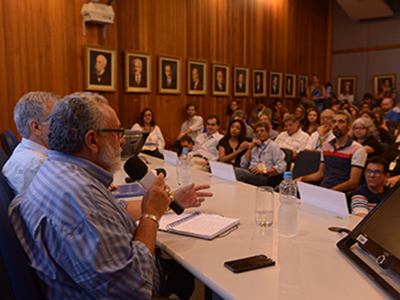 The director of IOC, Wilson Savino, highlighted the importance of partnerships between institutions and solidarity between researchers in times of crisis. Photo: Gutemberg Brito
In his welcoming speech at the opening table, the director of IOC, Wilson Savino, highlighted the importance of investing in partnerships between future masters and doctors with researchers and institutions, especially in times of crisis.
"The mark of solidarity must be everlasting and even brighter in adverse situations. Working and showing solidarity are great forms of resistance", highlighted Savino.
Also present at the ceremony, the vice-president of Education, Information and Communication of Fiocruz, Manoel Barral Neto, drew attention to issues that affect the scope of postgraduate studies. He pointed to the need for integration between teaching programs, the importance of scientific dissemination strategies and the promotion of debate around ethical aspects related to the development of research.
"We need to think about sharing knowledge, disciplines and internships, and expand this in a harmonic and non-impositional way, encouraging these contacts to flourish and progress. Technology, for example, favors the issue of sharing", emphasized Barral.
On the occasion, the student representative of the IOC, Geovane Dias Lopes, recalled the centenary of Oswaldo Cruz's death, celebrated in February 2017, and the sanitarian's commitment to combating yellow fever and diseases such as smallpox and bubonic plague.
"Oswaldo boosted the establishment of the institution from an intense health campaign linked to a strong political action. Without harmony between the two instances, it becomes difficult to do science", he highlighted.
"In the year of the centenary of the death of Oswaldo Cruz, a scientist who at the beginning of the last century committed himself to eradicating yellow fever from the then capital of the country [Rio de Janeiro], within a period of three years, to discuss the clinical, epidemiological and preventive aspects of the disease is very pertinent", declared researcher Marcelo Pelajo Machado before starting to present the main challenges and advances in relation to the condition over time.
In a beautiful walk through history, Pelajo went from the creation of the prophylaxis service, in 1903, which aimed to regulate and consolidate the campaign to combat the disease, to the Nobel Prize awarded to Max Theiler, in 1951, for the development of the vaccine used until nowadays.
"It was the first time that the award was granted to the developer of an immunizer", he commented.
Machado is curator of Yellow Fever Collection IOC, which contains 498 cases, liver samples collected by viscerotomy between the 1930s and 1970s. The collection also brings together a vast amount of written, printed and iconographic documentation, mainly consisting of research protocols, records of cases of the disease, files with histopathology reports, in addition to photos of individuals and collection sites.
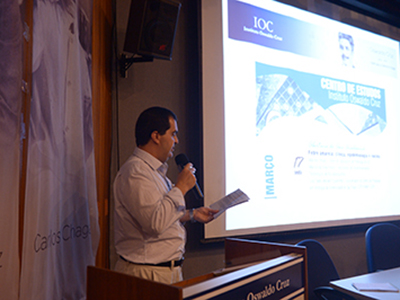 In a historical rescue of yellow fever, the researcher from the IOC Marcelo Pelajo Machado recalled Oswaldo Cruz's commitment to eradicating the disease in Rio de Janeiro at the beginning of the XNUMXth century. Photo: Gutemberg Brito
Deputy Director of Technological Development at Bio-Manguinhos, F unitiocruz that produces the vaccine for yellow fever, Marcos Freire commented that the immunizer manufacturing process has not undergone major changes since its creation in the 1930s.
"The heart of the yellow fever vaccine production process is the same: the use of embryonated eggs. The improvements implemented in recent decades include improvements such as thermostability, which facilitates vaccination in rural areas, and greater quality control of the product," he explained.
He also highlighted that the increase in knowledge of the ability to induce the immune response and adverse reactions has made the vaccine safer.
"Bio-Manguinhos currently operates in the monthly production of about 8 million doses of the vaccine", he pointed out.
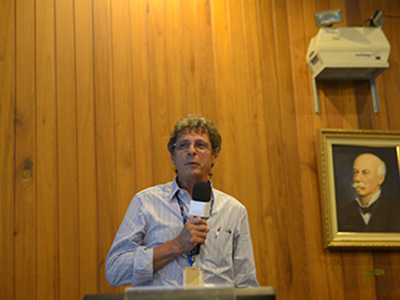 Studies on the ability to induce the immune response and adverse reactions of the vaccine made the vaccine safer, according to researcher Marcos Freire, from Bio-Manguinhos. Photo: Gutemberg Brito
Freire also drew attention to new approaches to immunizing production, highlighting the work being carried out by researchers at the Aggeu Magalhães Research Center (CPqAM/Fiocruz-PE). The study is based on the production of a DNA molecule capable of originating yellow fever virus proteins.
"The DNA molecule is completely inert. Once placed inside an individual, virus proteins are produced and then antibodies are generated. This causes immunization to occur without the presence of the pathogen. The principle of this immunizer is well similar to what is being developed against Zika", he commented.
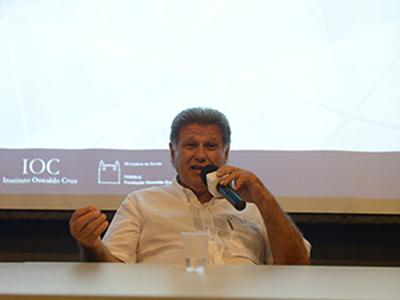 For USP researcher Luiz Tadeu Figueiredo, vaccination is essential to prevent yellow fever from reaching the population in urban centers. Photo: Gutemberg Brito
Regarding the possibility of urbanization of the disease, the scientist from the University of São Paulo (USP), Luiz Tadeu Figueiredo, who coordinates the Center for Research in Virology at the Faculty of Medicine of Ribeirão Preto, explained that the only possibility for the disease to reach the centers urban areas is if there is no adequate vaccination program.
"I was one of the first to insist on vaccinating the population of Rio de Janeiro as soon as cases appeared in Minas Gerais. The best way to contain the spread of the disease is through immunization", he pointed out.
The clinical aspects of the disease - such as symptoms that can include fever, chills, body aches and weakness - were also highlighted by the researcher.
Target of an intense sanitary campaign undertaken by Oswaldo Cruz, urban yellow fever was eradicated from Rio de Janeiro at the beginning of the 1940th century. In Brazil, the last record of the urban cycle of the disease dates from the XNUMXs, in Acre. However, given the current public health scenario in the country, the reemergence of this form of transmission has been considered a possibility.
Present daily in the news and a challenge for researchers and managers, yellow fever was the opening theme of the Academic Year of the Oswaldo Cruz Institute (IOC/Fiocruz). Held last Friday, 17/03, the activity, which kicked off the 2017 edition of the Centro de Estudos do IOC - the institution's most traditional academic activity - was attended by the head of the Pathology Laboratory of the IOC, Marcelo Pelajo Machado, the deputy director of Technological Development at Bio-Manguinhos, Marcos da Silva Freire, and the coordinator of the Center for Research in Virology at the University of São Paulo, Luiz Tadeu Moraes Figueiredo. The historical and clinical aspects and the impacts of the disease in the country were discussed.
The director of IOC, Wilson Savino, highlighted the importance of partnerships between institutions and solidarity between researchers in times of crisis. Photo: Gutemberg Brito
In his welcoming speech at the opening table, the director of IOC, Wilson Savino, highlighted the importance of investing in partnerships between future masters and doctors with researchers and institutions, especially in times of crisis.
"The mark of solidarity must be everlasting and even brighter in adverse situations. Working and showing solidarity are great forms of resistance", highlighted Savino.
Also present at the ceremony, the vice-president of Education, Information and Communication of Fiocruz, Manoel Barral Neto, drew attention to issues that affect the scope of postgraduate studies. He pointed to the need for integration between teaching programs, the importance of scientific dissemination strategies and the promotion of debate around ethical aspects related to the development of research.
"We need to think about sharing knowledge, disciplines and internships, and expand this in a harmonic and non-impositional way, encouraging these contacts to flourish and progress. Technology, for example, favors the issue of sharing", emphasized Barral.
On the occasion, the student representative of the IOC, Geovane Dias Lopes, recalled the centenary of Oswaldo Cruz's death, celebrated in February 2017, and the sanitarian's commitment to combating yellow fever and diseases such as smallpox and bubonic plague.
"Oswaldo boosted the establishment of the institution from an intense health campaign linked to a strong political action. Without harmony between the two instances, it becomes difficult to do science", he highlighted.
"In the year of the centenary of the death of Oswaldo Cruz, a scientist who at the beginning of the last century committed himself to eradicating yellow fever from the then capital of the country [Rio de Janeiro], within a period of three years, to discuss the clinical, epidemiological and preventive aspects of the disease is very pertinent", declared researcher Marcelo Pelajo Machado before starting to present the main challenges and advances in relation to the condition over time.
In a beautiful walk through history, Pelajo went from the creation of the prophylaxis service, in 1903, which aimed to regulate and consolidate the campaign to combat the disease, to the Nobel Prize awarded to Max Theiler, in 1951, for the development of the vaccine used until nowadays.
"It was the first time that the award was granted to the developer of an immunizer", he commented.
Machado is curator of Yellow Fever Collection IOC, which contains 498 cases, liver samples collected by viscerotomy between the 1930s and 1970s. The collection also brings together a vast amount of written, printed and iconographic documentation, mainly consisting of research protocols, records of cases of the disease, files with histopathology reports, in addition to photos of individuals and collection sites.
In a historical rescue of yellow fever, the researcher from the IOC Marcelo Pelajo Machado recalled Oswaldo Cruz's commitment to eradicating the disease in Rio de Janeiro at the beginning of the XNUMXth century. Photo: Gutemberg Brito
Deputy Director of Technological Development at Bio-Manguinhos, F unitiocruz that produces the vaccine for yellow fever, Marcos Freire commented that the immunizer manufacturing process has not undergone major changes since its creation in the 1930s.
"The heart of the yellow fever vaccine production process is the same: the use of embryonated eggs. The improvements implemented in recent decades include improvements such as thermostability, which facilitates vaccination in rural areas, and greater quality control of the product," he explained.
He also highlighted that the increase in knowledge of the ability to induce the immune response and adverse reactions has made the vaccine safer.
"Bio-Manguinhos currently operates in the monthly production of about 8 million doses of the vaccine", he pointed out.
Studies on the ability to induce the immune response and adverse reactions of the vaccine made the vaccine safer, according to researcher Marcos Freire, from Bio-Manguinhos. Photo: Gutemberg Brito
Freire also drew attention to new approaches to immunizing production, highlighting the work being carried out by researchers at the Aggeu Magalhães Research Center (CPqAM/Fiocruz-PE). The study is based on the production of a DNA molecule capable of originating yellow fever virus proteins.
"The DNA molecule is completely inert. Once placed inside an individual, virus proteins are produced and then antibodies are generated. This causes immunization to occur without the presence of the pathogen. The principle of this immunizer is well similar to what is being developed against Zika", he commented.
For USP researcher Luiz Tadeu Figueiredo, vaccination is essential to prevent yellow fever from reaching the population in urban centers. Photo: Gutemberg Brito
Regarding the possibility of urbanization of the disease, the scientist from the University of São Paulo (USP), Luiz Tadeu Figueiredo, who coordinates the Center for Research in Virology at the Faculty of Medicine of Ribeirão Preto, explained that the only possibility for the disease to reach the centers urban areas is if there is no adequate vaccination program.
"I was one of the first to insist on vaccinating the population of Rio de Janeiro as soon as cases appeared in Minas Gerais. The best way to contain the spread of the disease is through immunization", he pointed out.
The clinical aspects of the disease - such as symptoms that can include fever, chills, body aches and weakness - were also highlighted by the researcher.
The non-profit reproduction of the text is allowed as long as the source is cited (Comunicação / Instituto Oswaldo Cruz)
 |
 |
