
The Oswaldo Cruz Institute (IOC/Fiocruz) and the company Mosquito & Pests Solutions Importação e Exportação de Tecnologias Ltda signed, last Thursday (30/01), a partnership agreement for co-development, production and commercialization of an innovative technology to combat mosquitoes.
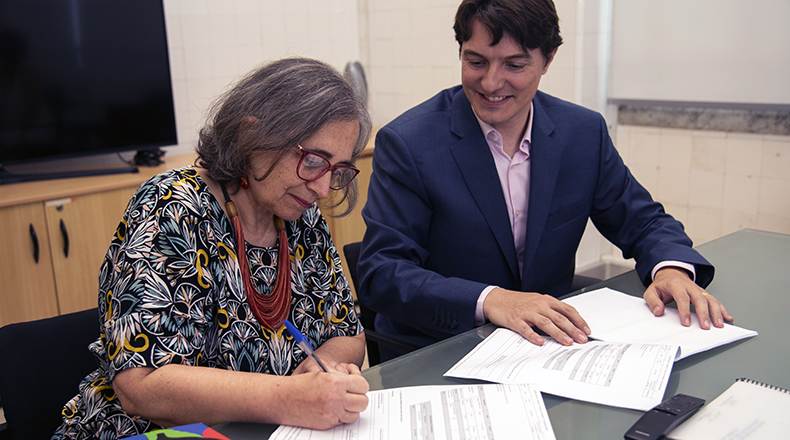 Tania and Rodrigo during the signing of the partnership agreement. Photo: Ricardo Schmidt
The technology works as a complementary alternative for controlling mosquito populations that act as disease vectors (especially Aedes aegypti), to be added to mechanical control, carried out through the manual removal of breeding sites.
The device consists of a technology for spreading insecticides. Among the main differences of this innovation are its simple design, which does not require electrostatic or high-tech components and the need to change chemical components at long intervals (every 12 or 20 weeks).
From the moment of signature, the IOC and the partner company are committed to developing the technology in a joint and scalable manner, ensuring logistical and industrial viability, with a focus on enabling use in the public and private markets, both nationally and internationally.
The partnership includes registration with regulatory agencies and protection of intellectual property, in addition to the production and commercialization of the new technology, which is currently under development.
“Starting the year in which the Institute celebrates 125 years of existence with the signing of this partnership is a gift,” commented Tania Araujo-Jorge, director of the Institute.
Researcher José Bento Pereira Lima, one of the project coordinators and head of the Laboratory of Biology, Control and Surveillance of Insect Vectors at IOC, highlighted that the technology has low production costs, sustainability and usability and is more durable compared to those available on the market.
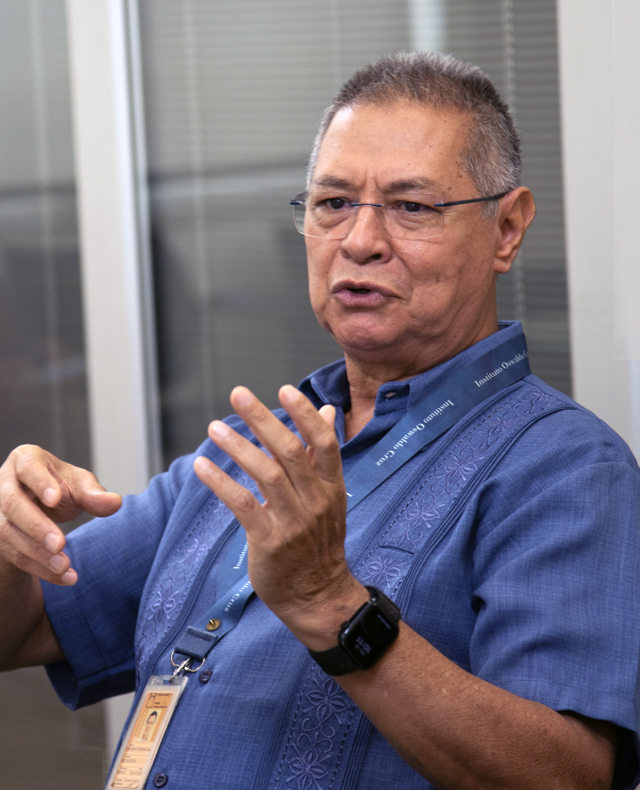 José Bento highlighted the positive aspects of the new technology. Photo: Ricardo Schmidt
Rodrigo Monteiro, managing partner of the partner company, commented on the relationship between the private market and academia in the country.
“In the United States, for example, this interaction is common. Here in Brazil, there is still some difficulty in establishing this exchange, especially because companies do not understand how long the innovative process has been going on in the country,” he said, highlighting that Mosquito & Pests Solutions will also be responsible for exploring the technology in other countries.
For the deputy director of Research, Technological Development and Innovation at IOC, Ademir Martins, moments like these encourage the Institute's scientific community to think about the innovative potential of their projects.
“By strengthening the Technological Innovation Center (NIT/IOC), whose work was fundamental to the signing of this agreement, and the holding of themed events, we will seek to continually promote the culture of innovation within the Institute”, he commented during the signing ceremony.
Regarding the work of NIT, Aline Morais, coordinator of the Research and Innovation Support Platform (PAPI/IOC), said that the Center is focused on drafting the patent application for the invention related to the technology, the filing of which was unanimously approved by the Patent Commission of the Federal District.iocroz.
The NIT-IOC is responsible for supporting innovation management at the Institute, acting as a link between scientific research and the public and private markets. For more information about the available technologies or to start the partnership process, interested parties should send an email to nit @ioc.fiocruz.br.
The Oswaldo Cruz Institute (IOC/Fiocruz) and the company Mosquito & Pests Solutions Importação e Exportação de Tecnologias Ltda signed, last Thursday (30/01), a partnership agreement for co-development, production and commercialization of an innovative technology to combat mosquitoes.
Tania and Rodrigo during the signing of the partnership agreement. Photo: Ricardo Schmidt
The technology works as a complementary alternative for controlling mosquito populations that act as disease vectors (especially Aedes aegypti), to be added to mechanical control, carried out through the manual removal of breeding sites.
The device consists of a technology for spreading insecticides. Among the main differences of this innovation are its simple design, which does not require electrostatic or high-tech components and the need to change chemical components at long intervals (every 12 or 20 weeks).
From the moment of signature, the IOC and the partner company are committed to developing the technology in a joint and scalable manner, ensuring logistical and industrial viability, with a focus on enabling use in the public and private markets, both nationally and internationally.
The partnership includes registration with regulatory agencies and protection of intellectual property, in addition to the production and commercialization of the new technology, which is currently under development.
“Starting the year in which the Institute celebrates 125 years of existence with the signing of this partnership is a gift,” commented Tania Araujo-Jorge, director of the Institute.
Researcher José Bento Pereira Lima, one of the project coordinators and head of the Laboratory of Biology, Control and Surveillance of Insect Vectors at IOC, highlighted that the technology has low production costs, sustainability and usability and is more durable compared to those available on the market.
José Bento highlighted the positive aspects of the new technology. Photo: Ricardo Schmidt
Rodrigo Monteiro, managing partner of the partner company, commented on the relationship between the private market and academia in the country.
“In the United States, for example, this interaction is common. Here in Brazil, there is still some difficulty in establishing this exchange, especially because companies do not understand how long the innovative process has been going on in the country,” he said, highlighting that Mosquito & Pests Solutions will also be responsible for exploring the technology in other countries.
For the deputy director of Research, Technological Development and Innovation at IOC, Ademir Martins, moments like these encourage the Institute's scientific community to think about the innovative potential of their projects.
“By strengthening the Technological Innovation Center (NIT/IOC), whose work was fundamental to the signing of this agreement, and the holding of themed events, we will seek to continually promote the culture of innovation within the Institute”, he commented during the signing ceremony.
Regarding the work of NIT, Aline Morais, coordinator of the Research and Innovation Support Platform (PAPI/IOC), said that the Center is focused on drafting the patent application for the invention related to the technology, the filing of which was unanimously approved by the Patent Commission of the Federal District.iocroz.
The NIT-IOC is responsible for supporting innovation management at the Institute, acting as a link between scientific research and the public and private markets. For more information about the available technologies or to start the partnership process, interested parties should send an email to nit @ioc.fiocruz.br.
The non-profit reproduction of the text is allowed as long as the source is cited (Comunicação / Instituto Oswaldo Cruz)
 |
 |
