
A study led by the Oswaldo Cruz Institute (IOC/Fiocruz) points out that mosquitoes Aedes aegypti e Culex quinquefasciatus They present different reactions to light and heat stimuli, fundamental factors in regulating the biological clock of living beings.
While Culex – popularly known as mosquito or midge – guides its activity and rest cycles mainly by variations in light, the vector of dengue, Zika and chikungunya is more influenced by temperature.
Published in the scientific journal 'Journal of Biological Rhythms', the finding may have an impact on the spread of diseases, since locomotion patterns interfere with important aspects of insect biology, including metabolism, energy expenditure, well-being and efficiency for pathogen transmission.
At the head of a group of scientists dedicated to studying the circadian rhythms of disease vector insects, researcher Rafaela Vieira Bruno, head of the Laboratory of Molecular Biology of Insects at IOC and coordinator of the study, states that the behavior of the C. quinquefasciatus is similar to that of other insects already studied. Already the reaction of A. aegypti is unexpected.
“Most research related to the circadian rhythm of mosquitoes is carried out with light and dark cycles, to simulate day and night, and a constant temperature of 25°C. However, in nature, temperature varies along with luminosity and this is an important factor in adjusting the biological clock. In our work, we simulated different light and heat conditions. We observed that Culex maintain their nocturnal pattern of locomotion, regardless of temperature changes. On the other hand, Aedes – which are normally diurnal – switch from day to night when faced with a 'cold day' and a 'warm night'”, reports the biologist.
The research had the collaboration of the Laboratories of Molecular Biology of Insects, of Mosquitoes Transmitting Hematozoans and of Physiology and Control of Arthropod Vectors of the IOC, in addition to the Army Institute of Biology (Ibex) and the National Institute of Science and Technology in Molecular Entomology (INCT-EM).
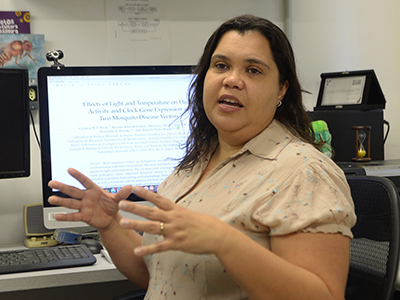
Rafaela Bruno explains that environmental conditions act to adjust the biological clock, synchronizing circadian rhythms. Photo: Gutemberg Brito
All living beings have mechanisms to adjust their behavior to 24-hour daily cycles.
The alternation between wakefulness and sleep is the classic example of the circadian rhythm, but several other behaviors are regulated by the biological clock. In mosquitoes, the most important are locomotor activity, reproduction, searching for breeding sites, laying eggs and searching for hosts – that is, a source of blood for food.
These behaviors are guided by genes, known as clock genes, which act in the brain and in different tissues of insects.
“The biological clock is adjusted by environmental conditions. Light and dark cycles and temperature are generally the most important factors in regulating the expression of clock genes, which in turn guide insect behavior. In the presence of environmental variations, circadian rhythms are synchronized,” explains Rafaela.
To assess the regulation of the mosquitoes' biological clock, the researchers ran a series of simulations.
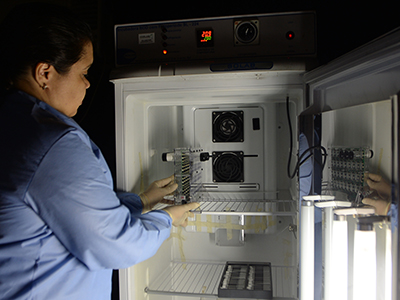
In an incubator, the insects were subjected to varying light and heat conditions.
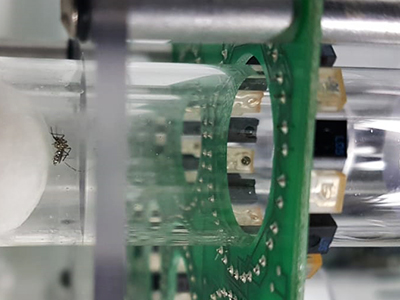
Locomotion was monitored by infrared sensors capable of detecting the movement of insects inside test tubes. The activation of clock genes was analyzed at regular intervals of every two hours.
The first experiment used conditions similar to those found in nature. The records from the Vila Militar weather station in the North Zone of Rio de Janeiro were used to establish average daytime temperatures of 30ºC and nighttime temperatures of 20ºC.
In this scenario, Aedes moved more during the day and Culex at night. Both species showed a peak of activity just after dusk.
According to Rafaela, the Aedes locomotion pattern was different from that observed in experiments with a constant temperature of 25ºC. “In light and dark cycles without temperature variation, Aedes exhibit two peaks of activity: at dusk and at dawn. Interestingly, we observed that the morning peak was suppressed when temperature acted as an additional factor for adjusting the biological clock,” comments the researcher.
The influence of temperature alone was evaluated in two simulations: one without any light and another with constant lighting.
In both conditions, the alternation between heat and cold was sufficient to maintain the general pattern of insect activity, with minor changes. In the absence of light, there was a reduction in the peak movement of both species.
The tendency of Aedes to move more during the hot hours, which normally correspond to the daytime, was accentuated. Culex – which maintained the habit of moving more during the cold period, associated with the night – had their peak movement brought forward by a few hours.

Finally, to investigate which stimulus would be predominant for the mosquitoes' behavior, the researchers used conflicting conditions of light and heat.
Faced with cycles of light at 20ºC and darkness at 30ºC, the Aedes adjusted their biological clocks to the temperature and began to move more at night.
Following the light, the Culex maintained their nocturnal activity, despite the heat.
Thus, the insects' locomotion peaks became dissociated: while Culex continued to have peak activity at dusk, Aedes began to show maximum locomotion a few hours before dawn.
As expected, the activation pattern of most clock genes varied as a function of different stimuli.
In both species, the presence of conflicting light and temperature conditions altered the gene expression profile, and in some cases, the changes occurred in opposite directions – for example, with an earlier activation time for a given gene in one species and a later activation time in the other.
For scientists, this divergence may be one of the explanations for the different reactions of insects to stimuli.
“Our work confirms that, just like light and dark cycles, temperature variations are important for the development of the circadian rhythms of mosquitoes, especially Aedes. The great sensitivity of this vector to heat is a factor that can have an epidemiological impact, since behaviors such as locomotor activity and host search can influence disease transmission,” ponders Rafaela.
A study led by the Oswaldo Cruz Institute (IOC/Fiocruz) points out that mosquitoes Aedes aegypti e Culex quinquefasciatus They present different reactions to light and heat stimuli, fundamental factors in regulating the biological clock of living beings.
While Culex – popularly known as mosquito or midge – guides its activity and rest cycles mainly by variations in light, the vector of dengue, Zika and chikungunya is more influenced by temperature.
Published in the scientific journal 'Journal of Biological Rhythms', the finding may have an impact on the spread of diseases, since locomotion patterns interfere with important aspects of insect biology, including metabolism, energy expenditure, well-being and efficiency for pathogen transmission.
At the head of a group of scientists dedicated to studying the circadian rhythms of disease vector insects, researcher Rafaela Vieira Bruno, head of the Laboratory of Molecular Biology of Insects at IOC and coordinator of the study, states that the behavior of the C. quinquefasciatus is similar to that of other insects already studied. Already the reaction of A. aegypti is unexpected.
“Most research related to the circadian rhythm of mosquitoes is carried out with light and dark cycles, to simulate day and night, and a constant temperature of 25°C. However, in nature, temperature varies along with luminosity and this is an important factor in adjusting the biological clock. In our work, we simulated different light and heat conditions. We observed that Culex maintain their nocturnal pattern of locomotion, regardless of temperature changes. On the other hand, Aedes – which are normally diurnal – switch from day to night when faced with a 'cold day' and a 'warm night'”, reports the biologist.
The research had the collaboration of the Laboratories of Molecular Biology of Insects, of Mosquitoes Transmitting Hematozoans and of Physiology and Control of Arthropod Vectors of the IOC, in addition to the Army Institute of Biology (Ibex) and the National Institute of Science and Technology in Molecular Entomology (INCT-EM).
Rafaela Bruno explains that environmental conditions act to adjust the biological clock, synchronizing circadian rhythms. Photo: Gutemberg Brito
All living beings have mechanisms to adjust their behavior to 24-hour daily cycles.
The alternation between wakefulness and sleep is the classic example of the circadian rhythm, but several other behaviors are regulated by the biological clock. In mosquitoes, the most important are locomotor activity, reproduction, searching for breeding sites, laying eggs and searching for hosts – that is, a source of blood for food.
These behaviors are guided by genes, known as clock genes, which act in the brain and in different tissues of insects.
“The biological clock is adjusted by environmental conditions. Light and dark cycles and temperature are generally the most important factors in regulating the expression of clock genes, which in turn guide insect behavior. In the presence of environmental variations, circadian rhythms are synchronized,” explains Rafaela.
To assess the regulation of the mosquitoes' biological clock, the researchers ran a series of simulations.
In an incubator, the insects were subjected to varying light and heat conditions.
Locomotion was monitored by infrared sensors capable of detecting the movement of insects inside test tubes. The activation of clock genes was analyzed at regular intervals of every two hours.
The first experiment used conditions similar to those found in nature. The records from the Vila Militar weather station in the North Zone of Rio de Janeiro were used to establish average daytime temperatures of 30ºC and nighttime temperatures of 20ºC.
In this scenario, Aedes moved more during the day and Culex at night. Both species showed a peak of activity just after dusk.
According to Rafaela, the Aedes locomotion pattern was different from that observed in experiments with a constant temperature of 25ºC. “In light and dark cycles without temperature variation, Aedes exhibit two peaks of activity: at dusk and at dawn. Interestingly, we observed that the morning peak was suppressed when temperature acted as an additional factor for adjusting the biological clock,” comments the researcher.
The influence of temperature alone was evaluated in two simulations: one without any light and another with constant lighting.
In both conditions, the alternation between heat and cold was sufficient to maintain the general pattern of insect activity, with minor changes. In the absence of light, there was a reduction in the peak movement of both species.
The tendency of Aedes to move more during the hot hours, which normally correspond to the daytime, was accentuated. Culex – which maintained the habit of moving more during the cold period, associated with the night – had their peak movement brought forward by a few hours.

Finally, to investigate which stimulus would be predominant for the mosquitoes' behavior, the researchers used conflicting conditions of light and heat.
Faced with cycles of light at 20ºC and darkness at 30ºC, the Aedes adjusted their biological clocks to the temperature and began to move more at night.
Following the light, the Culex maintained their nocturnal activity, despite the heat.
Thus, the insects' locomotion peaks became dissociated: while Culex continued to have peak activity at dusk, Aedes began to show maximum locomotion a few hours before dawn.
As expected, the activation pattern of most clock genes varied as a function of different stimuli.
In both species, the presence of conflicting light and temperature conditions altered the gene expression profile, and in some cases, the changes occurred in opposite directions – for example, with an earlier activation time for a given gene in one species and a later activation time in the other.
For scientists, this divergence may be one of the explanations for the different reactions of insects to stimuli.
“Our work confirms that, just like light and dark cycles, temperature variations are important for the development of the circadian rhythms of mosquitoes, especially Aedes. The great sensitivity of this vector to heat is a factor that can have an epidemiological impact, since behaviors such as locomotor activity and host search can influence disease transmission,” ponders Rafaela.
The non-profit reproduction of the text is allowed as long as the source is cited (Comunicação / Instituto Oswaldo Cruz)
 |
 |
