
Research based on cutting-edge computational methodologies has advanced the understanding of one of the central steps involved in the infection of human cells by the parasite. trypanosoma cruzi, which causes Chagas disease.
By building an unprecedented model of the molecules involved in this process, mapping 1,44 million atoms, the study identified targets that could be the starting point for the development of new therapies.
Published in the international scientific journal 'Biochemistry', highlighted on the cover of the publication, the finding is the result of collaboration with the Oswaldo Cruz Institute (IOC/Fiocruz), through the Graduate Program in Computational Biology and Systems, with the Federal University of Rio de Janeiro (UFRJ) and Auburn University, in the United States.
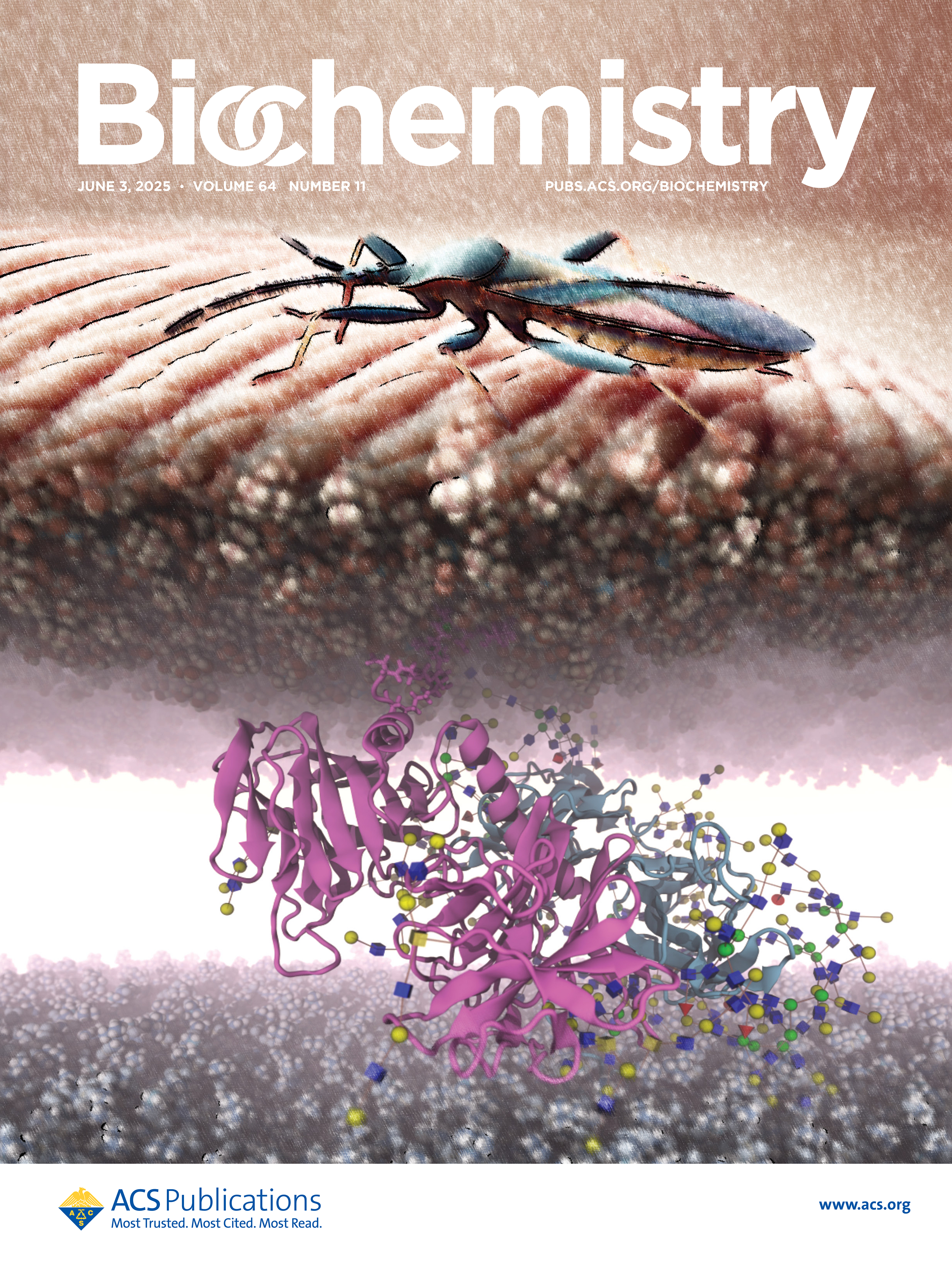 Illustration on the cover of 'B' magazineiochemistry' shows a barber on the skin and, below, the computational model developed by researchers at Fiocruz, UFRJ and Auburn University that presents the interaction between molecules of trypanosoma cruzi and the human cell. Image: BiocHemistry/ACS Publications
The investigation focused on two molecules: the gp82 protein, present on the surface of the T. cruzi, and the LAMP2 protein, found in the membrane of human cells. During infection, the binding between these proteins allows the parasite to invade cells in various human organs.
The scientists highlight that the work constructed the first complete computational model of the complex formed by gp82 and LAMP2 with atomic resolution, that is, representing each atom of the molecules involved in the system.
"We used microsecond-scale molecular dynamics simulations in a system with 1,44 million atoms, including the two proteins, the membranes of both organisms, and other molecules that interfere in this interaction, such as glycans. This allowed us to investigate, with unprecedented precision, how these molecules interact in the biological environment," explains Raíssa Rosa, PhD in Computational and Systems Biology from IOC.
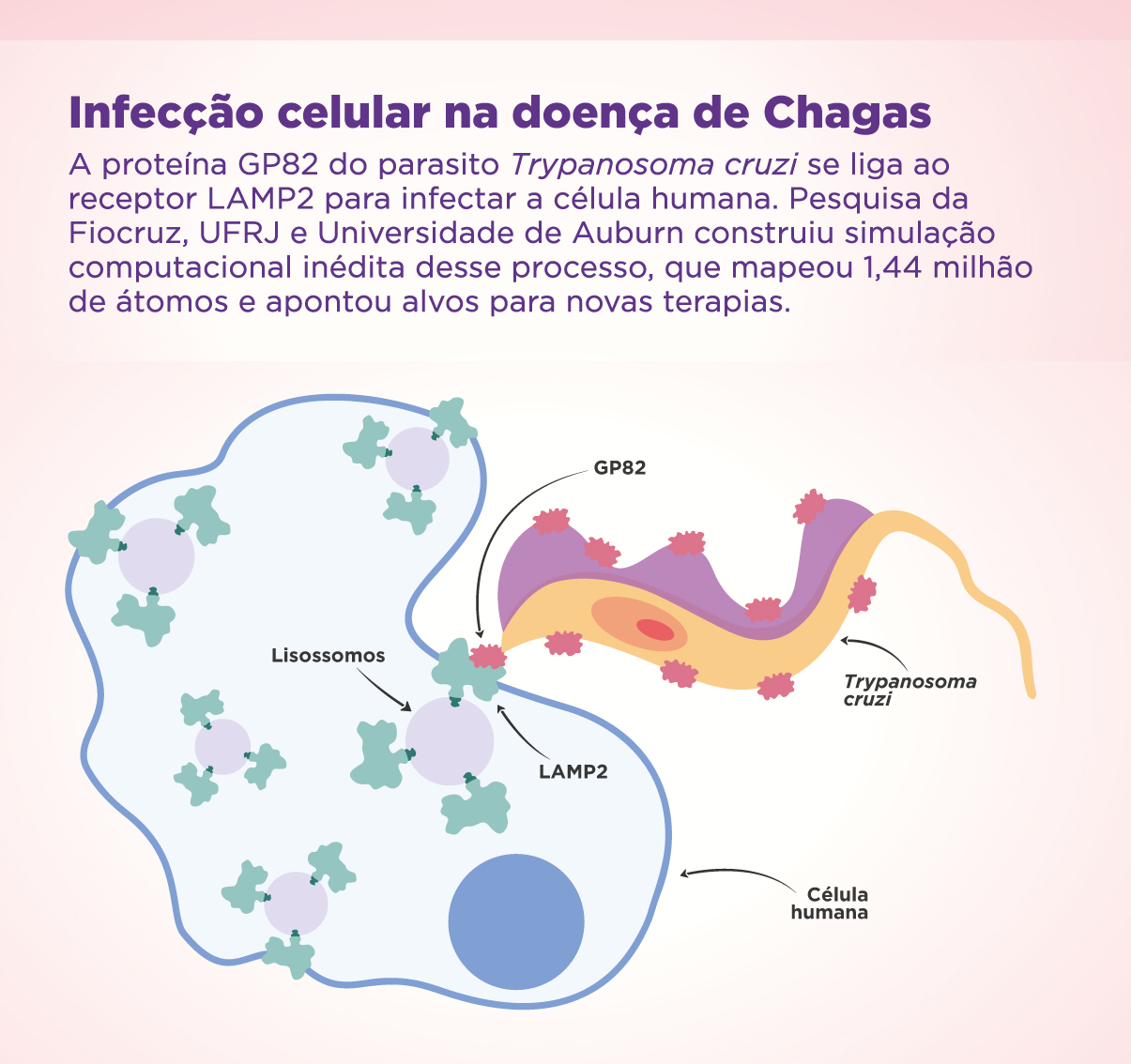 Illustration adapted from the article 'Atomistic insights into gp82 binding: a microsecond, million-atom exploration of Trypanosoma cruzi host-cell invasion'. Art: Jefferson Mendes
Among the main results, the analysis mapped the protein segments with the most important role in establishing the connection between gp82 and LAMP2, corroborating and expanding the findings of experimental tests.
"Only two previous articles had identified residues critical to this interaction based on bench experiments. In the computational simulation, we demonstrated the relevance of these previously identified residues and identified others that had not yet been described. The alignment with experimental tests reinforces the validity of the developed model, which can be explored in other future research," says Manuela Leal da Silva, a professor in the Postgraduate Program in Computational and Systems Biology and Raíssa's advisor.
The findings open doors to search for molecules capable of acting at key points in the gp82-LAMP2 interaction, in order to prevent cellular invasion by the parasite, which could be the basis for new treatments or vaccines.
"Therapy development is always a long and costly process, which becomes even more difficult for neglected diseases. Computational work can shorten this process by directing the search for biopharmaceuticals. Even so, investment is crucial, because several stages of testing are necessary before a therapy actually reaches patients," says Rafael Bernardi, a researcher at Auburn University who supervised Raíssa during her PhD internship.
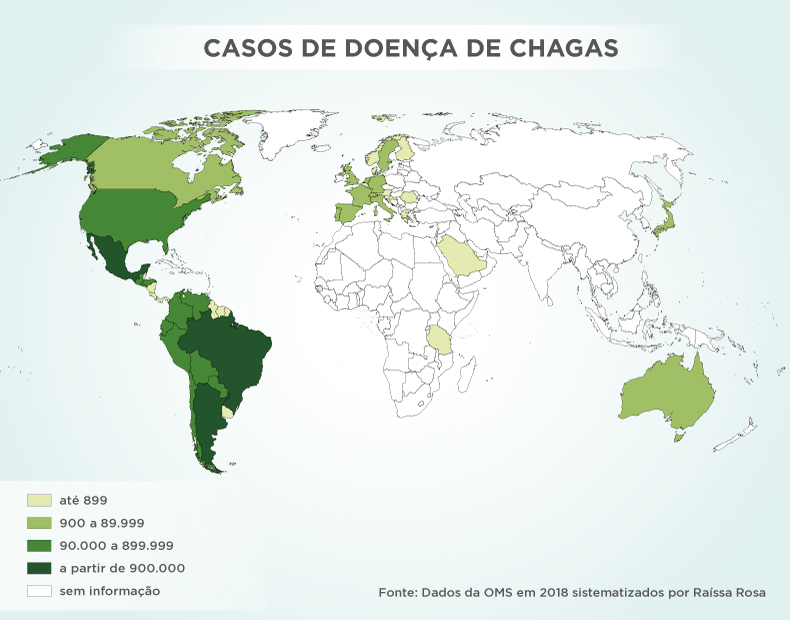 WHO data shows that Chagas disease has spread to several regions around the world, beyond the traditionally affected area of Latin America. The lack of information about the infection in many countries may indicate underreporting and an even greater impact of the disease. Art: Jefferson Mendes
Scientists emphasize the importance of applying cutting-edge methodologies in the search for new strategies against Chagas disease.
"Currently available treatments for the condition are highly toxic, making adherence difficult. Ideally, new treatments for the disease should be developed, and considering the still high prevalence of the infection in several countries, a preventive strategy, such as a vaccine, would also be important," says Manuela, who also works as a professor at the Institute of Biodiversity and Sustainability at the Federal University of Rio de Janeiro (UFRJ), better known as NUPEM.
The study was funded by the Coordination for the Improvement of Higher Education Personnel (Capes) and the National Council for Scientific and Technological Development (CNPq), in Brazil, and by the National Science Foundation (NSF) and the National Institutes of Health (NIH), in the United States.
Biomedical scientist Raíssa Rosa's sandwich doctoral period at Auburn University, where the computational experiments were carried out, was funded by the Capes Print Program, through the award of a scholarship, and extended with support from North American resources.
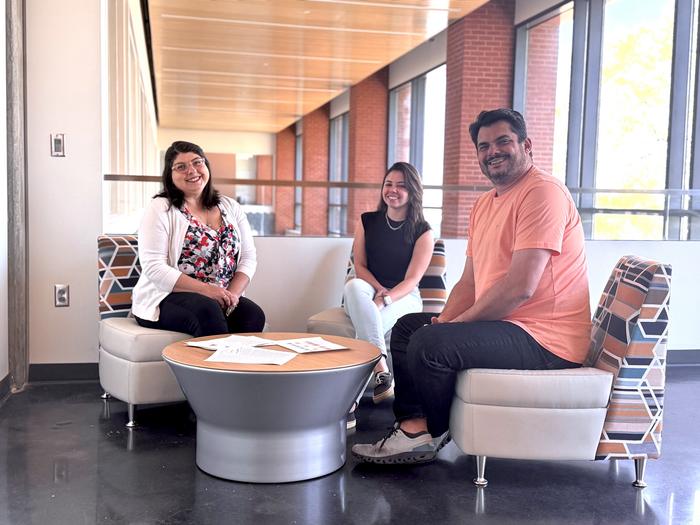 Manuela Leal da Silva, Raíssa Rosa, and Rafael Bernardi at Auburn University in the United States. Photo: Auburn Physics
The researchers emphasize the importance of international collaboration in the project and in the training of young scientists.
“Neglected infections are not a focus of research in the United States and it was very productive to combine our expertise in computational biophysics with the knowledge of Fiocruz, who is a leader in research into Chagas disease,” said Rafael.
"In addition to the solid, interdisciplinary training, the Graduate Program in Computational and Systems Biology provided me with access to national and international research networks and opportunities for exchange and participation in cutting-edge projects. This study demonstrates how Brazilian groups are excelling in applying advanced computational modeling to understand complex biological processes. It's a growing field with great potential," emphasizes Raíssa, who defended her doctoral thesis in May and is currently participating in a summer internship program as a research associate at the Center for Computational Biology at the Flatiron Institute in New York.
According to the World Health Organization (WHO), Chagas disease affects more than 7 million people worldwide, causing approximately 10 deaths each year. Approximately 100 million individuals live at risk of infection.
Most cases are concentrated in Latin America, where triatomine bugs, popularly known as kissing bugs, which transmit the infection, are found.
However, the pattern of the disease has changed in recent decades, mainly due to population mobility, urbanization and migration.
Chagas disease, which was predominantly rural and restricted to Latin America, is now characterized as predominantly urban and is widespread across the planet, with a growing number of cases in Canada, the United States, and European, African, and Asian countries.
*Article:
ROSA, RSL; DA SILVA, M.; BERNARDI, RC Atomistic Insights into gp82 Binding: A Microsecond, Million-Atom Exploration of Trypanosoma cruzi Host-Cell Invasion. Biochemistry, v. 64, n. 11, p. 2476–2488, 2025. Available at: https://doi.org/10.1021/acs.biochem.4c00710.
Research based on cutting-edge computational methodologies has advanced the understanding of one of the central steps involved in the infection of human cells by the parasite. trypanosoma cruzi, which causes Chagas disease.
By building an unprecedented model of the molecules involved in this process, mapping 1,44 million atoms, the study identified targets that could be the starting point for the development of new therapies.
Published in the international scientific journal 'Biochemistry', highlighted on the cover of the publication, the finding is the result of collaboration with the Oswaldo Cruz Institute (IOC/Fiocruz), through the Graduate Program in Computational Biology and Systems, with the Federal University of Rio de Janeiro (UFRJ) and Auburn University, in the United States.
Illustration on the cover of 'B' magazineiochemistry' shows a barber on the skin and, below, the computational model developed by researchers at Fiocruz, UFRJ and Auburn University that presents the interaction between molecules of trypanosoma cruzi and the human cell. Image: BiocHemistry/ACS Publications
The investigation focused on two molecules: the gp82 protein, present on the surface of the T. cruzi, and the LAMP2 protein, found in the membrane of human cells. During infection, the binding between these proteins allows the parasite to invade cells in various human organs.
The scientists highlight that the work constructed the first complete computational model of the complex formed by gp82 and LAMP2 with atomic resolution, that is, representing each atom of the molecules involved in the system.
"We used microsecond-scale molecular dynamics simulations in a system with 1,44 million atoms, including the two proteins, the membranes of both organisms, and other molecules that interfere in this interaction, such as glycans. This allowed us to investigate, with unprecedented precision, how these molecules interact in the biological environment," explains Raíssa Rosa, PhD in Computational and Systems Biology from IOC.
Illustration adapted from the article 'Atomistic insights into gp82 binding: a microsecond, million-atom exploration of Trypanosoma cruzi host-cell invasion'. Art: Jefferson Mendes
Among the main results, the analysis mapped the protein segments with the most important role in establishing the connection between gp82 and LAMP2, corroborating and expanding the findings of experimental tests.
"Only two previous articles had identified residues critical to this interaction based on bench experiments. In the computational simulation, we demonstrated the relevance of these previously identified residues and identified others that had not yet been described. The alignment with experimental tests reinforces the validity of the developed model, which can be explored in other future research," says Manuela Leal da Silva, a professor in the Postgraduate Program in Computational and Systems Biology and Raíssa's advisor.
The findings open doors to search for molecules capable of acting at key points in the gp82-LAMP2 interaction, in order to prevent cellular invasion by the parasite, which could be the basis for new treatments or vaccines.
"Therapy development is always a long and costly process, which becomes even more difficult for neglected diseases. Computational work can shorten this process by directing the search for biopharmaceuticals. Even so, investment is crucial, because several stages of testing are necessary before a therapy actually reaches patients," says Rafael Bernardi, a researcher at Auburn University who supervised Raíssa during her PhD internship.
WHO data shows that Chagas disease has spread to several regions around the world, beyond the traditionally affected area of Latin America. The lack of information about the infection in many countries may indicate underreporting and an even greater impact of the disease. Art: Jefferson Mendes
Scientists emphasize the importance of applying cutting-edge methodologies in the search for new strategies against Chagas disease.
"Currently available treatments for the condition are highly toxic, making adherence difficult. Ideally, new treatments for the disease should be developed, and considering the still high prevalence of the infection in several countries, a preventive strategy, such as a vaccine, would also be important," says Manuela, who also works as a professor at the Institute of Biodiversity and Sustainability at the Federal University of Rio de Janeiro (UFRJ), better known as NUPEM.
The study was funded by the Coordination for the Improvement of Higher Education Personnel (Capes) and the National Council for Scientific and Technological Development (CNPq), in Brazil, and by the National Science Foundation (NSF) and the National Institutes of Health (NIH), in the United States.
Biomedical scientist Raíssa Rosa's sandwich doctoral period at Auburn University, where the computational experiments were carried out, was funded by the Capes Print Program, through the award of a scholarship, and extended with support from North American resources.
Manuela Leal da Silva, Raíssa Rosa, and Rafael Bernardi at Auburn University in the United States. Photo: Auburn Physics
The researchers emphasize the importance of international collaboration in the project and in the training of young scientists.
“Neglected infections are not a focus of research in the United States and it was very productive to combine our expertise in computational biophysics with the knowledge of Fiocruz, who is a leader in research into Chagas disease,” said Rafael.
"In addition to the solid, interdisciplinary training, the Graduate Program in Computational and Systems Biology provided me with access to national and international research networks and opportunities for exchange and participation in cutting-edge projects. This study demonstrates how Brazilian groups are excelling in applying advanced computational modeling to understand complex biological processes. It's a growing field with great potential," emphasizes Raíssa, who defended her doctoral thesis in May and is currently participating in a summer internship program as a research associate at the Center for Computational Biology at the Flatiron Institute in New York.
According to the World Health Organization (WHO), Chagas disease affects more than 7 million people worldwide, causing approximately 10 deaths each year. Approximately 100 million individuals live at risk of infection.
Most cases are concentrated in Latin America, where triatomine bugs, popularly known as kissing bugs, which transmit the infection, are found.
However, the pattern of the disease has changed in recent decades, mainly due to population mobility, urbanization and migration.
Chagas disease, which was predominantly rural and restricted to Latin America, is now characterized as predominantly urban and is widespread across the planet, with a growing number of cases in Canada, the United States, and European, African, and Asian countries.
*Article:
ROSA, RSL; DA SILVA, M.; BERNARDI, RC Atomistic Insights into gp82 Binding: A Microsecond, Million-Atom Exploration of Trypanosoma cruzi Host-Cell Invasion. Biochemistry, v. 64, n. 11, p. 2476–2488, 2025. Available at: https://doi.org/10.1021/acs.biochem.4c00710.
The non-profit reproduction of the text is allowed as long as the source is cited (Comunicação / Instituto Oswaldo Cruz)
 |
 |
