
Bringing together a broad genetic and epidemiological database, a study led by the Oswaldo Cruz Institute (IOC/Fiocruz) and the University of Oxford, in the United Kingdom, brings contributions on the spread of the largest outbreak of yellow fever recorded in Brazil in almost eighty years.
The work presents the sequencing of 62 viral genomes from cases registered between 2016 and 2017, significantly expanding the information available for analysis.
The article confirms that the outbreak was caused by the spread of the wild form of the disease. In addition, it reinforces the hypothesis that the virus was introduced in Minas Gerais from the North region of Brazil and, after the first cases in the state, it spread quickly - calculations indicate that it would have covered, on average, 4,25 km per day.
Carried out in cooperation by scientists from around 30 institutions in Brazil, the United Kingdom, the United States, France, Belgium and South Africa, in partnership with the Secretariat for Surveillance and Health of the Ministry of Health (SVS/MS) and the Pan American Organization (Opas), the study was published in the international journal Science.
 According to Luiz Alcantara, the association between genomic and epidemiological surveillance can help to understand and anticipate epidemics. Photo: Gutemberg Brito
These results reinforce the importance of genomic surveillance, associated with epidemiological surveillance, to understand the evolution of viral lineages over time and try to anticipate the occurrence of epidemics.
"The fact that the virus was introduced in Minas Gerais from the North region points out that it is also necessary to carry out surveillance in endemic areas, where the virus persists even in periods of epidemiological silence", says researcher Luiz Alcantara, from the Flavivirus Laboratory of IOC and research leader in Brazil.
To arrive at the findings, the researchers initially analyzed the epidemiological information related to the place and date of occurrence of 683 human cases and 313 primate infections, reported in the state of Minas Gerais, considered the epicenter of the outbreak.
The mapping showed that, on average, human infections occurred four days after records in monkeys. It was also verified, from data crossings, that the infected patients lived around 1,7 km from the nearest place of animal infection.
In addition, 85% of those infected were men, a profile that coincides with that of rural workers and people who move frequently in forested areas, which increases the chances of infection.
According to Alcantara, the analyzes suggest the existence of a risk group for the infection, which can guide future vaccination actions in already endemic areas.
"Our analyzes show that most cases occurred in cities in Minas Gerais with vaccination coverage greater than 80%. However, confirmed cases occurred mostly in men, aged 40 to 49 years old, who were not vaccinated. This group , made up mainly of rural workers with occupational activities that involve direct contact with the forest, should be a focus of vaccination actions in the future", he emphasizes.
The decoding of the viral genomes was the next stage of the research. Using portable equipment for genetic sequencing, the researchers were able to decode 51 samples from Minas Gerais.
This work was possible from the experience of the ZIBRA project [acronym for Zika in Brazil Real Time Analysis - in free translation, Analysis in Real Time of Zika in Brazil], in which we used this portable sequencer for the first time.
By developing a protocol for the sequencing of the yellow fever virus, we were able, in less than two weeks, to obtain around 51 genomes”, reports Alcantara. Using traditional laboratory techniques, eight more genomes from Espírito Santo were sequenced, two from Rio de Janeiro and one from Bahia.
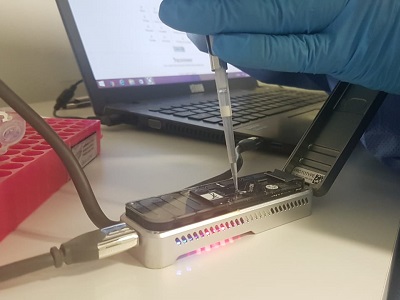 The researchers were able to decode 51 samples from Minas Gerais using portable equipment for genetic sequencing. Photo: Gutemberg Brito
The 62 new decoded genomes were compared with 61 yellow fever virus genetic sequences available in public databases for the construction of phylogenetic trees - a type of analysis that groups viruses that share a common ancestor on the same branch, similar to trees genealogical.
The researchers observed that all the viruses from the last yellow fever outbreak recorded in Brazil would group together in a branch, which would indicate the presence of a single common ancestor. They also verified that this ancestor would be closer to a virus that circulated in Roraima in 2002 than to the strain that circulated in Minas Gerais in 2003.
"We can estimate that the strain that caused the outbreak was introduced in Minas Gerais in July 2016, coming from the North Region, spreading across the state and then to other areas in the Southeast", points out Alcantara.
By joining the epidemiological and GPS data of the cases and the information from the phylogenetic analyses, the researchers were able to calculate the speed at which the virus was spreading: 4,25 km per day.
Considering the estimated starting location of the outbreak, the disease occurrence area expanded continuously between August 2016 and July 2017. Regarding the pace of expansion of the outbreak border, a rate of 3,3 km per day was calculated, about.
Different data reinforce that the spread of the disease occurred solely through the sylvatic cycle of yellow fever - a circuit in which the virus is transmitted by forest mosquitoes to monkeys, and human beings are accidentally infected when penetrating or approaching forest areas. According to Alcantara, the research suggests that human action may have contributed to the rapid spread of the disease in wild areas.
"The virus advanced faster than would be expected considering the natural movement of monkeys and mosquitoes in the region. The trafficking of animals or even the transport of infected insects in vehicles may have contributed to accelerate the expansion of the outbreak", ponders the researcher.
Bringing together a broad genetic and epidemiological database, a study led by the Oswaldo Cruz Institute (IOC/Fiocruz) and the University of Oxford, in the United Kingdom, brings contributions on the spread of the largest outbreak of yellow fever recorded in Brazil in almost eighty years.
The work presents the sequencing of 62 viral genomes from cases registered between 2016 and 2017, significantly expanding the information available for analysis.
The article confirms that the outbreak was caused by the spread of the wild form of the disease. In addition, it reinforces the hypothesis that the virus was introduced in Minas Gerais from the North region of Brazil and, after the first cases in the state, it spread quickly - calculations indicate that it would have covered, on average, 4,25 km per day.
Carried out in cooperation by scientists from around 30 institutions in Brazil, the United Kingdom, the United States, France, Belgium and South Africa, in partnership with the Secretariat for Surveillance and Health of the Ministry of Health (SVS/MS) and the Pan American Organization (Opas), the study was published in the international journal Science.
According to Luiz Alcantara, the association between genomic and epidemiological surveillance can help to understand and anticipate epidemics. Photo: Gutemberg Brito
These results reinforce the importance of genomic surveillance, associated with epidemiological surveillance, to understand the evolution of viral lineages over time and try to anticipate the occurrence of epidemics.
"The fact that the virus was introduced in Minas Gerais from the North region points out that it is also necessary to carry out surveillance in endemic areas, where the virus persists even in periods of epidemiological silence", says researcher Luiz Alcantara, from the Flavivirus Laboratory of IOC and research leader in Brazil.
To arrive at the findings, the researchers initially analyzed the epidemiological information related to the place and date of occurrence of 683 human cases and 313 primate infections, reported in the state of Minas Gerais, considered the epicenter of the outbreak.
The mapping showed that, on average, human infections occurred four days after records in monkeys. It was also verified, from data crossings, that the infected patients lived around 1,7 km from the nearest place of animal infection.
In addition, 85% of those infected were men, a profile that coincides with that of rural workers and people who move frequently in forested areas, which increases the chances of infection.
According to Alcantara, the analyzes suggest the existence of a risk group for the infection, which can guide future vaccination actions in already endemic areas.
"Our analyzes show that most cases occurred in cities in Minas Gerais with vaccination coverage greater than 80%. However, confirmed cases occurred mostly in men, aged 40 to 49 years old, who were not vaccinated. This group , made up mainly of rural workers with occupational activities that involve direct contact with the forest, should be a focus of vaccination actions in the future", he emphasizes.
The decoding of the viral genomes was the next stage of the research. Using portable equipment for genetic sequencing, the researchers were able to decode 51 samples from Minas Gerais.
This work was possible from the experience of the ZIBRA project [acronym for Zika in Brazil Real Time Analysis - in free translation, Analysis in Real Time of Zika in Brazil], in which we used this portable sequencer for the first time.
By developing a protocol for the sequencing of the yellow fever virus, we were able, in less than two weeks, to obtain around 51 genomes”, reports Alcantara. Using traditional laboratory techniques, eight more genomes from Espírito Santo were sequenced, two from Rio de Janeiro and one from Bahia.
The researchers were able to decode 51 samples from Minas Gerais using portable equipment for genetic sequencing. Photo: Gutemberg Brito
The 62 new decoded genomes were compared with 61 yellow fever virus genetic sequences available in public databases for the construction of phylogenetic trees - a type of analysis that groups viruses that share a common ancestor on the same branch, similar to trees genealogical.
The researchers observed that all the viruses from the last yellow fever outbreak recorded in Brazil would group together in a branch, which would indicate the presence of a single common ancestor. They also verified that this ancestor would be closer to a virus that circulated in Roraima in 2002 than to the strain that circulated in Minas Gerais in 2003.
"We can estimate that the strain that caused the outbreak was introduced in Minas Gerais in July 2016, coming from the North Region, spreading across the state and then to other areas in the Southeast", points out Alcantara.
By joining the epidemiological and GPS data of the cases and the information from the phylogenetic analyses, the researchers were able to calculate the speed at which the virus was spreading: 4,25 km per day.
Considering the estimated starting location of the outbreak, the disease occurrence area expanded continuously between August 2016 and July 2017. Regarding the pace of expansion of the outbreak border, a rate of 3,3 km per day was calculated, about.
Different data reinforce that the spread of the disease occurred solely through the sylvatic cycle of yellow fever - a circuit in which the virus is transmitted by forest mosquitoes to monkeys, and human beings are accidentally infected when penetrating or approaching forest areas. According to Alcantara, the research suggests that human action may have contributed to the rapid spread of the disease in wild areas.
"The virus advanced faster than would be expected considering the natural movement of monkeys and mosquitoes in the region. The trafficking of animals or even the transport of infected insects in vehicles may have contributed to accelerate the expansion of the outbreak", ponders the researcher.
The non-profit reproduction of the text is allowed as long as the source is cited (Comunicação / Instituto Oswaldo Cruz)
 |
 |
