
Researchers and students from the Oswaldo Cruz Institute (IOC/Fiocruz) provided information and prevention actions against mosquitoes Aedes aegypti to hundreds of people during the 'Bem Estar Global' event, in Cuiabá, Mato Grosso, on November 11th.
During the initiative, carried out by TV Globo in partnership with the Industrial Social Service (SESI), experts developed a series of theoretical and practical activities to show that, in a simple way, it is possible to prevent the proliferation of the mosquito that transmits dengue viruses, Zika and chikungunya.
The participation of the IOC at the event was an invitation from the production and had the support of the Vice-directorate of Teaching, Information and Communication of the IOC and Postgraduate Programs Strict sensu in Parasite Biology and Cellular and Molecular Biology from the Institute, as part of social inclusion activities.
 The activities drew attention to attitudes that prevent the spread of mosquitoes Aedes aegypti
Based on the theme '10 Minutes against Aedes', games and games caught the attention of those passing by.
In addition to entertaining, the activities provided information about habits, preferences, food and egg laying.
"To combat Aedes, it is important to know it. As it lives in and around our homes, we need to be alert to potential mosquito breeding sites, such as water tanks, drains, air conditioning and refrigerator trays and objects scattered around backyard that can accumulate water, for example", explained Ademir Martins, researcher at the Laboratory of Physiology and Control of Arthropod Vectors at the IOC, and one of the coordinators of the Institute's activities.
Participants were able to view the mosquito up close in each of its four stages of development: egg, larva, pupa and adult mosquito. Retired Maria Sebastiana Lopes, who participated in the event alongside family and friends, highlighted the opportunity to learn new knowledge.
"I learned that the heat of Cuiabá can help with the development of the mosquito that transmits Zika and dengue. It is important to pay attention to care at home and avoid leaving standing water. Now it is time to pass on the information to help reduce the transmission of diseases", said Sebastiana .
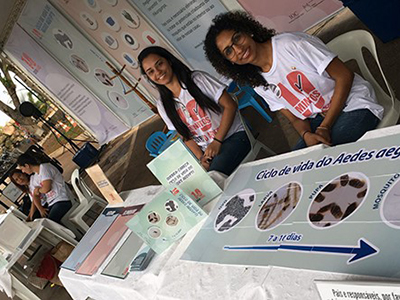 The Aedes life cycle was one of the highlights of the IOC In the event. Participants were able to view the mosquito's four life stages: egg, larva, pupa and adult
"Ten minutes a week is enough to carry out a complete inspection of balconies, backyards and inside houses to eliminate potential Aedes breeding sites. Weekly intervention can interrupt the mosquito's development cycle, which lasts 7 to 10 days", he added. Rafaela Vieira Bruno, researcher at the Insect Molecular Biology Laboratory at the IOC, who also coordinated the Institute’s activities.
Researchers and students from the Oswaldo Cruz Institute (IOC/Fiocruz) provided information and prevention actions against mosquitoes Aedes aegypti to hundreds of people during the 'Bem Estar Global' event, in Cuiabá, Mato Grosso, on November 11th.
During the initiative, carried out by TV Globo in partnership with the Industrial Social Service (SESI), experts developed a series of theoretical and practical activities to show that, in a simple way, it is possible to prevent the proliferation of the mosquito that transmits dengue viruses, Zika and chikungunya.
The participation of the IOC at the event was an invitation from the production and had the support of the Vice-directorate of Teaching, Information and Communication of the IOC and Postgraduate Programs Strict sensu in Parasite Biology and Cellular and Molecular Biology from the Institute, as part of social inclusion activities.
The activities drew attention to attitudes that prevent the spread of mosquitoes Aedes aegypti
Based on the theme '10 Minutes against Aedes', games and games caught the attention of those passing by.
In addition to entertaining, the activities provided information about habits, preferences, food and egg laying.
"To combat Aedes, it is important to know it. As it lives in and around our homes, we need to be alert to potential mosquito breeding sites, such as water tanks, drains, air conditioning and refrigerator trays and objects scattered around backyard that can accumulate water, for example", explained Ademir Martins, researcher at the Laboratory of Physiology and Control of Arthropod Vectors at the IOC, and one of the coordinators of the Institute's activities.
Participants were able to view the mosquito up close in each of its four stages of development: egg, larva, pupa and adult mosquito. Retired Maria Sebastiana Lopes, who participated in the event alongside family and friends, highlighted the opportunity to learn new knowledge.
"I learned that the heat of Cuiabá can help with the development of the mosquito that transmits Zika and dengue. It is important to pay attention to care at home and avoid leaving standing water. Now it is time to pass on the information to help reduce the transmission of diseases", said Sebastiana .
The Aedes life cycle was one of the highlights of the IOC In the event. Participants were able to view the mosquito's four life stages: egg, larva, pupa and adult
"Ten minutes a week is enough to carry out a complete inspection of balconies, backyards and inside houses to eliminate potential Aedes breeding sites. Weekly intervention can interrupt the mosquito's development cycle, which lasts 7 to 10 days", he added. Rafaela Vieira Bruno, researcher at the Insect Molecular Biology Laboratory at the IOC, who also coordinated the Institute’s activities.
The non-profit reproduction of the text is allowed as long as the source is cited (Comunicação / Instituto Oswaldo Cruz)
 |
 |
